Ch. 28 - Pericyclic Reactions
Bruice - Organic Chemistry 8th Edition
Bruice8th EditionOrganic ChemistryISBN: 9780135213711Not the one you use?Change textbook
Chapter 25, Problem 33

If the compounds shown here are heated, one will form one product from a [1,3] sigmatropic rearrangement and the other will form two products from two different [1,3] sigmatropic rearrangements. Draw the products of the reactions.
Two chemical structures illustrating [1,3] sigmatropic rearrangements with labeled substituents and bonds.

Verified step by step guidance
1
Identify the compounds involved in the problem and determine their structural features. Look for allylic systems or conjugated systems that are capable of undergoing a [1,3] sigmatropic rearrangement.
Recall the mechanism of a [1,3] sigmatropic rearrangement. This involves the migration of a substituent (such as a hydrogen or alkyl group) along with the simultaneous shift of a π-bond. The reaction is pericyclic and follows the conservation of orbital symmetry.
For the compound that forms one product, analyze the possible rearrangement pathways. Identify the group that migrates and the new position of the π-bond. Draw the resulting product structure.
For the compound that forms two products, consider the two possible [1,3] sigmatropic rearrangement pathways. Each pathway will involve a different migrating group or a different π-bond shift. Draw the two resulting product structures.
Verify the products by checking that the rearrangements conserve the total number of π-electrons and that the resulting structures are consistent with the rules of pericyclic reactions. Ensure that the products are valid resonance structures or stable isomers of the starting material.

Verified video answer for a similar problem:

This video solution was recommended by our tutors as helpful for the problem above.
Video duration:
10m
Was this helpful?

Key Concepts

Here are the essential concepts you must grasp in order to answer the question correctly.

[1,3] Sigmatropic Rearrangement

[1,3] sigmatropic rearrangement is a type of pericyclic reaction where a sigma bond and a pi bond rearrange to form new sigma bonds. This process involves the migration of a substituent from one atom to another, typically occurring in a concerted manner. The reaction is characterized by the movement of atoms or groups across a three-atom framework, leading to the formation of different structural isomers.
Recommended video:
Guided course
03:20
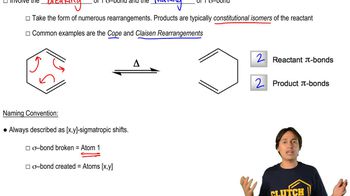
Nomenclature of Sigmatropic Shifts

Pericyclic Reactions

Pericyclic reactions are a class of organic reactions that occur through a cyclic transition state and involve the concerted rearrangement of bonding electrons. These reactions include cycloadditions, sigmatropic rearrangements, and electrocyclic reactions. They are governed by the principles of orbital symmetry, which dictate the feasibility and outcome of the reaction based on the alignment of molecular orbitals.
Recommended video:
Guided course
07:37
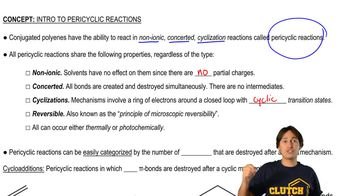
Properties and Types of Pericyclic Reactions

Product Distribution

Product distribution in organic reactions refers to the variety and relative amounts of products formed from a given reactant under specific conditions. In the context of sigmatropic rearrangements, the distribution can depend on factors such as sterics, electronics, and the stability of the resulting products. Understanding product distribution is crucial for predicting reaction outcomes and designing synthetic pathways.
Recommended video:
Guided course
11:07
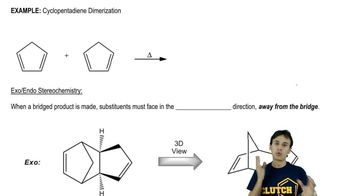
Bridged-Products