Ch. 3 - An Introduction to Organic Compounds:Nomenclature, Physical Properties, and Structure
Bruice - Organic Chemistry 8th Edition
Bruice8th EditionOrganic ChemistryISBN: 9780135213711Not the one you use?Change textbook
Chapter 4, Problem 59(1)

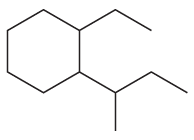
a. How many primary carbons does each of the following compounds have?
b. How many secondary carbons does each one have?
c. How many tertiary carbons does each one have?
1. Chemical structure diagram showing carbon rings and branches for identifying primary, secondary, and tertiary carbons.

Verified step by step guidance
1
Step 1: Identify the structure of the compound. The image shows a cyclohexane ring with one methyl group attached to the top carbon and two methyl groups attached to the bottom carbon.
Step 2: Define primary, secondary, and tertiary carbons. A primary carbon is bonded to only one other carbon atom, a secondary carbon is bonded to two other carbon atoms, and a tertiary carbon is bonded to three other carbon atoms.
Step 3: Analyze the structure for primary carbons. The methyl groups attached to the ring are primary carbons because each is bonded to only one other carbon atom.
Step 4: Analyze the structure for secondary carbons. The carbons in the cyclohexane ring that are bonded to two other carbons are secondary carbons.
Step 5: Analyze the structure for tertiary carbons. The bottom carbon in the cyclohexane ring is a tertiary carbon because it is bonded to three other carbons (two from the ring and one from the methyl group).

Verified video answer for a similar problem:

This video solution was recommended by our tutors as helpful for the problem above.
Video duration:
4m
Was this helpful?

Key Concepts

Here are the essential concepts you must grasp in order to answer the question correctly.

Primary Carbons

Primary carbons are carbon atoms that are bonded to only one other carbon atom. They are typically found at the ends of carbon chains or branches. In organic compounds, identifying primary carbons is crucial for understanding the structure and reactivity of the molecule.
Recommended video:
1:11
Primary Protein Structure Example 1

Secondary Carbons

Secondary carbons are carbon atoms that are bonded to two other carbon atoms. These carbons are often located in the middle of carbon chains or branches. Recognizing secondary carbons is important for predicting the behavior of the compound during chemical reactions, especially in substitution and elimination processes.
Recommended video:
1:50
Secondary Protein Structure Concept 1

Tertiary Carbons

Tertiary carbons are carbon atoms that are bonded to three other carbon atoms. They are typically found in branched structures and play a significant role in the stability and reactivity of organic compounds. Understanding tertiary carbons is essential for grasping concepts like carbocation stability and reaction mechanisms.
Recommended video:
2:07
Tertiary Protein Structure Concept 1