Ch. 3 - An Introduction to Organic Compounds:Nomenclature, Physical Properties, and Structure
Bruice - Organic Chemistry 8th Edition
Bruice8th EditionOrganic ChemistryISBN: 9780135213711Not the one you use?Change textbook
Chapter 4, Problem 7c

Draw the structure for each of the following:
c. sec-butyl iodide

Verified step by step guidance
1
Step 1: Understand the term 'sec-butyl'. The prefix 'sec-' refers to a secondary carbon, meaning the functional group is attached to a carbon that is bonded to two other carbons. 'Butyl' indicates a four-carbon chain.
Step 2: Begin by drawing the backbone of the molecule. Create a four-carbon chain (butane) and identify the secondary carbon. This is the second carbon in the chain, which is bonded to two other carbons.
Step 3: Attach the iodine atom (I) to the secondary carbon. This makes it 'sec-butyl iodide', as the iodine is bonded to the secondary carbon in the butyl group.
Step 4: Add hydrogens to the remaining open bonds of the carbon atoms to satisfy the valency of carbon (which is 4). Ensure each carbon has the correct number of bonds.
Step 5: Verify the structure. Confirm that the molecule has a total of four carbons, one iodine atom attached to the secondary carbon, and the correct number of hydrogens to complete the structure.

Verified video answer for a similar problem:

This video solution was recommended by our tutors as helpful for the problem above.
Video duration:
1m
Was this helpful?

Key Concepts

Here are the essential concepts you must grasp in order to answer the question correctly.

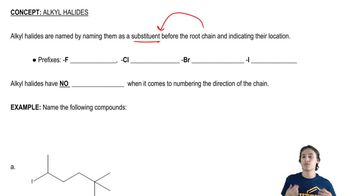
Alkyl Halides

Alkyl halides are organic compounds containing a carbon atom bonded to a halogen atom (such as iodine, bromine, or chlorine). They are classified based on the number of carbon atoms attached to the carbon bearing the halogen. Understanding the structure and reactivity of alkyl halides is crucial for drawing their chemical structures and predicting their behavior in reactions.
Recommended video:
Guided course
01:52
How to name alkyl halides

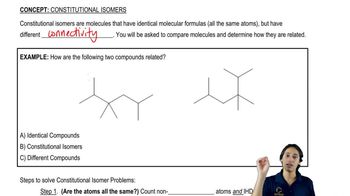
Structural Isomers

Structural isomers are compounds that have the same molecular formula but differ in the connectivity of their atoms. In the case of sec-butyl iodide, recognizing that it is a structural isomer of other butyl halides helps in understanding its unique properties and reactivity. This concept is essential for accurately representing the compound's structure.
Recommended video:
Guided course
01:10
What is a constitutional isomer?

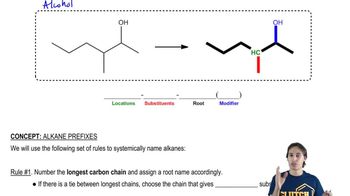
IUPAC Nomenclature

IUPAC nomenclature is a systematic method for naming organic chemical compounds. It provides rules for naming based on the structure of the molecule, including the longest carbon chain and the position of substituents. For sec-butyl iodide, knowing how to apply these rules allows for the correct identification and drawing of its structure, which is vital for communication in organic chemistry.
Recommended video:
Guided course
03:43
The different parts of an IUPAC name