Ch. 3 - An Introduction to Organic Compounds:Nomenclature, Physical Properties, and Structure
Bruice - Organic Chemistry 8th Edition
Bruice8th EditionOrganic ChemistryISBN: 9780135213711Not the one you use?Change textbook
Chapter 4, Problem 71a,b

For rotation about the C-3---C-4 bond of 2-methylhexane, do the following:
a. Draw the Newman projection of the most stable conformer.
b. Draw the Newman projection of the least stable conformer.

Verified step by step guidance
1
Step 1: Understand the structure of 2-methylhexane. The molecule consists of a six-carbon chain with a methyl group attached to the third carbon. The C-3-C-4 bond is the bond of interest for rotation.
Step 2: Identify the substituents on the C-3 and C-4 carbons. On C-3, there is a methyl group, a hydrogen atom, and the rest of the chain (C-1 and C-2). On C-4, there are two hydrogens and the rest of the chain (C-5 and C-6).
Step 3: To draw the most stable conformer, use a Newman projection. Place the C-3 carbon in the front circle and the C-4 carbon in the back circle. Arrange the substituents such that the bulky groups (the methyl group on C-3 and the chain on C-4) are staggered and as far apart as possible to minimize steric hindrance.
Step 4: To draw the least stable conformer, use a Newman projection again. This time, arrange the substituents such that the bulky groups (the methyl group on C-3 and the chain on C-4) are eclipsed, directly overlapping each other. This maximizes steric hindrance and torsional strain.
Step 5: Verify your drawings by ensuring that the substituents on both carbons are correctly represented in the Newman projections, and confirm that the most stable conformer minimizes steric hindrance while the least stable conformer maximizes it.

Verified video answer for a similar problem:

This video solution was recommended by our tutors as helpful for the problem above.
Video duration:
10m
Was this helpful?

Key Concepts

Here are the essential concepts you must grasp in order to answer the question correctly.

Newman Projections

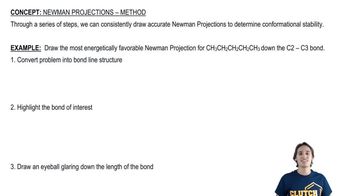
Newman projections are a way to visualize the conformation of a molecule by looking straight down the bond connecting two carbon atoms. This representation helps in analyzing steric interactions and torsional strain between substituents attached to the carbons, allowing chemists to identify stable and unstable conformers based on the spatial arrangement of these groups.
Recommended video:
Guided course
00:34
Introduction to Drawing Newman Projections

Conformational Stability

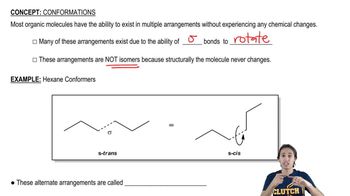
Conformational stability refers to the relative energy levels of different spatial arrangements of a molecule. In the case of 2-methylhexane, the most stable conformer minimizes steric hindrance and torsional strain, while the least stable conformer maximizes these interactions, leading to higher energy and less favorable arrangements. Understanding these concepts is crucial for predicting the behavior of molecules in various chemical reactions.
Recommended video:
Guided course
03:29
Understanding what a conformer is.

Steric Hindrance

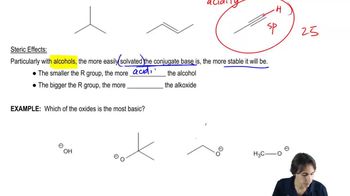
Steric hindrance occurs when atoms or groups within a molecule are forced close together, leading to repulsive interactions that increase the energy of the system. In 2-methylhexane, bulky groups can create steric strain when they are eclipsed in certain conformations, making those arrangements less stable. Recognizing how steric hindrance affects conformational stability is essential for drawing accurate Newman projections.
Recommended video:
Guided course
02:53
Understanding steric effects.