Ch. 3 - An Introduction to Organic Compounds:Nomenclature, Physical Properties, and Structure
Bruice - Organic Chemistry 8th Edition
Bruice8th EditionOrganic ChemistryISBN: 9780135213711Not the one you use?Change textbook
Chapter 4, Problem 27a,b

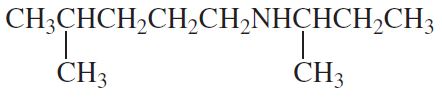
Give a systematic name and a common name (if it has one) for each of the following amines and indicate whether each is a primary, secondary, or tertiary amine:
a. Structural formula of hexylamine, a primary amine, represented as CH3CH2CH2CH2CH2CH2NH2.
b. Structural formulas of two amines with labels indicating their systematic and common names, and primary, secondary, or tertiary classification.

Verified step by step guidance
1
Step 1: Analyze the structure in part (i). The molecule consists of a straight chain of four carbon atoms with an amino group (-NH₂) attached to the terminal carbon. This indicates it is a primary amine because the nitrogen atom is bonded to only one carbon atom.
Step 2: Assign the systematic name for part (i). The parent chain is butane (four carbons), and the amino group is attached to the first carbon. The systematic name is 1-aminobutane.
Step 3: Determine the common name for part (i). The common name is derived by naming the alkyl group attached to the amino group. The alkyl group is butyl, so the common name is butylamine.
Step 4: Analyze the structure in part (ii). The molecule consists of a chain of four carbon atoms with a methyl group attached to the second carbon and an amino group (-NH) attached to the same second carbon. This indicates it is a secondary amine because the nitrogen atom is bonded to two carbon atoms.
Step 5: Assign the systematic name for part (ii). The parent chain is butane, and the amino group is attached to the second carbon along with a methyl substituent. The systematic name is N-methyl-2-aminobutane. The common name is sec-butylmethylamine.

Verified video answer for a similar problem:

This video solution was recommended by our tutors as helpful for the problem above.
Video duration:
4m
Was this helpful?

Key Concepts

Here are the essential concepts you must grasp in order to answer the question correctly.

Amines

Amines are organic compounds derived from ammonia (NH3) by replacing one or more hydrogen atoms with alkyl or aryl groups. They can be classified as primary (one alkyl group), secondary (two alkyl groups), or tertiary (three alkyl groups) based on the number of carbon-containing groups attached to the nitrogen atom. Understanding the structure of amines is crucial for naming them systematically.
Recommended video:
Guided course
07:12
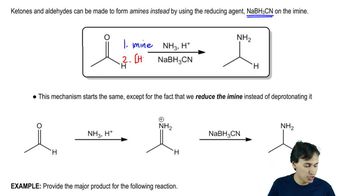
Reductive Amination

Systematic Naming

Systematic naming of amines follows the IUPAC nomenclature rules, where the longest carbon chain is identified, and the amine functional group is indicated by the suffix '-amine.' For primary amines, the name is derived from the corresponding alkane, while secondary and tertiary amines are named by identifying the substituents attached to the nitrogen atom. This systematic approach ensures clarity and consistency in chemical communication.
Recommended video:
Guided course
03:43
The different parts of an IUPAC name

Common Names

Common names for amines often arise from historical usage and may not follow systematic naming conventions. These names can be based on the structure or the source of the amine, such as 'ethylamine' for a primary amine derived from ethane. Familiarity with common names is important for recognizing and communicating about amines in both academic and practical contexts.
Recommended video:
Guided course
01:32
How to name ethers using the common naming system.