Ch. 3 - An Introduction to Organic Compounds:Nomenclature, Physical Properties, and Structure
Bruice - Organic Chemistry 8th Edition
Bruice8th EditionOrganic ChemistryISBN: 9780135213711Not the one you use?Change textbook
Chapter 4, Problem 20c,d

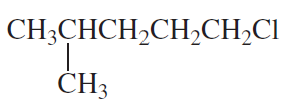
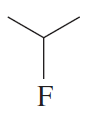
Give two names for each of the following alkyl halides and indicate whether each is primary, secondary, or tertiary:
c. Structural formula of an alkyl halide with a chlorine atom, indicating branching and carbon chain length.
d. Structural formula of an alkyl halide with a fluorine atom, indicating its branching and connectivity.

Verified step by step guidance
1
Step 1: Analyze the structure in part (i). The bromine atom (Br) is attached to a carbon that is connected to three other carbons. This makes the carbon a tertiary carbon. The compound is a tertiary alkyl halide.
Step 2: Name the structure in part (i) using IUPAC nomenclature. Identify the longest continuous chain of carbons, which is a four-carbon chain (butane). The bromine is attached to the second carbon. The IUPAC name is 2-bromo-2-methylpropane.
Step 3: Provide a common name for the structure in part (i). The structure can be named as tert-butyl bromide, as the bromine is attached to a tertiary butyl group.
Step 4: Analyze the structure in part (ii). The chlorine atom (Cl) is attached to a carbon that is connected to two other carbons. This makes the carbon a secondary carbon. The compound is a secondary alkyl halide.
Step 5: Name the structure in part (ii) using IUPAC nomenclature. Identify the longest continuous chain of carbons, which is a five-carbon chain (pentane). The chlorine is attached to the second carbon. The IUPAC name is 2-chloropentane. The common name for this structure is sec-pentyl chloride.

Verified video answer for a similar problem:

This video solution was recommended by our tutors as helpful for the problem above.
Video duration:
7m
Was this helpful?

Key Concepts

Here are the essential concepts you must grasp in order to answer the question correctly.

Alkyl Halides

Alkyl halides are organic compounds derived from alkanes by replacing one or more hydrogen atoms with halogen atoms (such as fluorine, chlorine, bromine, or iodine). They are classified based on the degree of substitution of the carbon atom bonded to the halogen: primary (1°), secondary (2°), or tertiary (3°). Understanding the structure of alkyl halides is crucial for naming and determining their reactivity.
Recommended video:
Guided course
01:52
How to name alkyl halides

Nomenclature

Nomenclature in organic chemistry refers to the systematic naming of chemical compounds based on established rules. For alkyl halides, the name typically includes the alkyl group followed by the halogen name, with appropriate prefixes indicating the number of halogen atoms. Familiarity with IUPAC naming conventions is essential for accurately identifying and communicating the structure of organic compounds.
Recommended video:
4:02
Nomenclature of Heterocycles Concept 2

Classification of Carbon Atoms

The classification of carbon atoms in organic compounds is based on the number of other carbon atoms bonded to them. A primary carbon is attached to one other carbon, a secondary carbon to two, and a tertiary carbon to three. This classification is important for predicting the reactivity and stability of alkyl halides, as the degree of substitution influences their chemical behavior in reactions.
Recommended video:
Guided course
01:44
The difference between atomic numbers and atomic mass.