Ch. 3 - An Introduction to Organic Compounds:Nomenclature, Physical Properties, and Structure
Bruice - Organic Chemistry 8th Edition
Bruice8th EditionOrganic ChemistryISBN: 9780135213711Not the one you use?Change textbook
Chapter 4, Problem 47

The chair conformer of fluorocyclohexane is 0.25 kcal/mol more stable when the fluoro substituent is in an equatorial position than when it is in an axial position. How much more stable is the anti conformer than a gauche conformer of 1-fluoropropane, considering rotation about the C1−C2 bond?

Verified step by step guidance
1
Understand the problem: The question involves comparing the stability of conformers in two different molecules. First, we are given the stability difference for fluorocyclohexane when the fluoro group is in the equatorial vs. axial position. Then, we are asked to determine the stability difference between the anti and gauche conformers of 1-fluoropropane, considering the steric and electronic interactions during rotation about the C1−C2 bond.
Recall the key concepts: In fluorocyclohexane, the equatorial position is more stable than the axial position due to reduced 1,3-diaxial interactions. For 1-fluoropropane, the anti conformer is more stable than the gauche conformer because the anti conformer minimizes steric hindrance and dipole-dipole repulsion between the fluorine atom and the other substituents.
Relate the stability difference: The stability difference between the anti and gauche conformers of 1-fluoropropane can be estimated using the given stability difference for fluorocyclohexane (0.25 kcal/mol). This is because the gauche interaction in 1-fluoropropane is analogous to the axial interaction in fluorocyclohexane, where steric and electronic effects are similar.
Set up the calculation: The anti conformer of 1-fluoropropane is more stable than the gauche conformer by approximately the same energy difference as the equatorial conformer of fluorocyclohexane is more stable than the axial conformer. Therefore, the stability difference between the anti and gauche conformers is approximately 0.25 kcal/mol.
Conclude: The anti conformer of 1-fluoropropane is approximately 0.25 kcal/mol more stable than the gauche conformer, based on the analogy to the stability difference in fluorocyclohexane.

Verified video answer for a similar problem:

This video solution was recommended by our tutors as helpful for the problem above.
Video duration:
2m
Was this helpful?

Key Concepts

Here are the essential concepts you must grasp in order to answer the question correctly.

Chair Conformation

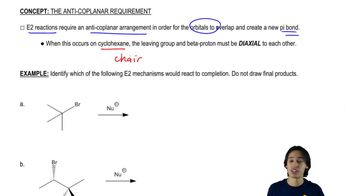
The chair conformation is a three-dimensional arrangement of cyclohexane that minimizes steric strain and torsional strain. In this conformation, substituents can occupy either equatorial or axial positions, with equatorial positions generally being more stable due to reduced steric hindrance. Understanding this concept is crucial for analyzing the stability of substituted cyclohexanes, such as fluorocyclohexane.
Recommended video:
Guided course
03:29
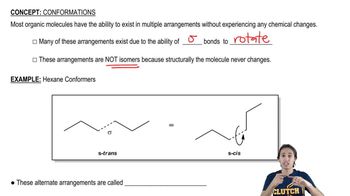
Understanding what a conformer is.

Gauche and Anti Conformers

In alkanes, conformers refer to different spatial arrangements of atoms that result from rotation around single bonds. The gauche conformer has substituents positioned 60 degrees apart, while the anti conformer has them 180 degrees apart. The anti conformer is typically more stable due to minimized steric interactions, making it essential to compare the stability of these conformers in molecules like 1-fluoropropane.
Recommended video:
Guided course
03:19
The Anti-Coplanar Requirement

Stability and Energy Differences

The stability of molecular conformers is often quantified in terms of energy differences, typically measured in kcal/mol. A lower energy state indicates greater stability, while a higher energy state suggests increased strain or steric hindrance. In the context of the question, understanding how to compare the energy differences between the anti and gauche conformers of 1-fluoropropane is key to determining their relative stability.
Recommended video:
Guided course
03:43
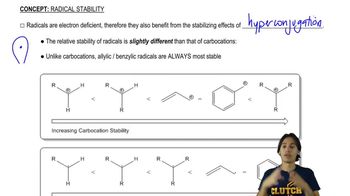
The radical stability trend.