Ch. 3 - An Introduction to Organic Compounds:Nomenclature, Physical Properties, and Structure
Bruice - Organic Chemistry 8th Edition
Bruice8th EditionOrganic ChemistryISBN: 9780135213711Not the one you use?Change textbook
Chapter 4, Problem 39

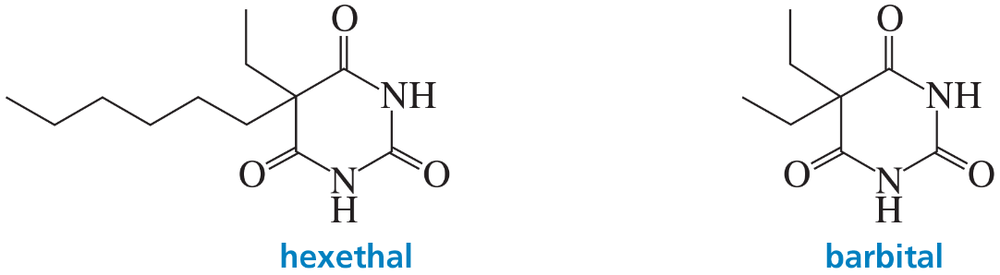
The effectiveness of a barbiturate as a sedative is related to its ability to penetrate the nonpolar membrane of a cell. Which of the following barbiturates would you expect to be the more effective sedative?

Verified step by step guidance
1
Step 1: Analyze the chemical structures of hexethal and barbital. Both are barbiturates with a similar core structure, but hexethal has a long nonpolar alkyl chain attached to its structure, while barbital has shorter substituents.
Step 2: Recall that the ability of a compound to penetrate a nonpolar cell membrane is influenced by its lipophilicity (nonpolar character). Compounds with more nonpolar groups are generally more lipophilic and can more easily cross the nonpolar lipid bilayer of cell membranes.
Step 3: Compare the substituents on hexethal and barbital. Hexethal's long alkyl chain increases its nonpolar character, making it more lipophilic compared to barbital, which has shorter substituents and is less nonpolar.
Step 4: Consider the relationship between lipophilicity and sedative effectiveness. A more lipophilic barbiturate is likely to penetrate the cell membrane more effectively, enhancing its sedative action.
Step 5: Based on the structural analysis and the principle of lipophilicity, hexethal is expected to be the more effective sedative due to its higher ability to penetrate the nonpolar cell membrane.

Verified video answer for a similar problem:

This video solution was recommended by our tutors as helpful for the problem above.
Video duration:
3m
Was this helpful?

Key Concepts

Here are the essential concepts you must grasp in order to answer the question correctly.

Lipophilicity

Lipophilicity refers to the chemical property of a substance that describes its affinity for lipids or fats. In the context of barbiturates, a higher lipophilicity indicates that the compound can more easily dissolve in nonpolar environments, such as cell membranes. This property is crucial for sedatives, as it affects their ability to cross the blood-brain barrier and exert their effects on the central nervous system.

Cell Membrane Structure

Cell membranes are primarily composed of a phospholipid bilayer, which creates a nonpolar environment that selectively allows certain substances to pass through. Understanding the structure of cell membranes is essential for predicting how well a drug, like a barbiturate, can penetrate these membranes. Compounds that are more nonpolar or lipophilic are generally more effective at crossing these barriers.
Recommended video:
3:26
Quaternary Protein Structure Concept 1

Sedative Mechanism of Action

Sedatives, including barbiturates, function by enhancing the inhibitory neurotransmitter gamma-aminobutyric acid (GABA) in the brain. This action leads to increased neuronal inhibition, resulting in calming effects. The effectiveness of a sedative is influenced by its ability to reach the central nervous system, which is closely tied to its chemical properties, such as lipophilicity and molecular size.
Recommended video:
Guided course
04:32
General Mechanism