Ch. 3 - An Introduction to Organic Compounds:Nomenclature, Physical Properties, and Structure
Bruice - Organic Chemistry 8th Edition
Bruice8th EditionOrganic ChemistryISBN: 9780135213711Not the one you use?Change textbook
Chapter 4, Problem 63a,b

Which has
a. the higher boiling point: 1-bromopentane or 1-bromohexane?
b. the higher boiling point: pentyl chloride or isopentyl chloride?

Verified step by step guidance
1
Step 1: Understand the factors affecting boiling points. Boiling points are influenced by molecular weight, intermolecular forces (such as van der Waals forces, dipole-dipole interactions, and hydrogen bonding), and molecular structure (branching reduces boiling points).
Step 2: Compare 1-bromopentane and 1-bromohexane. Both are alkyl bromides, but 1-bromohexane has a longer carbon chain (6 carbons) compared to 1-bromopentane (5 carbons). Longer chains increase molecular weight and surface area, leading to stronger van der Waals forces and a higher boiling point.
Step 3: Compare pentyl chloride and isopentyl chloride. Pentyl chloride is a straight-chain alkyl chloride, while isopentyl chloride is a branched isomer. Branching reduces the surface area available for intermolecular interactions, weakening van der Waals forces and lowering the boiling point. Therefore, pentyl chloride is expected to have a higher boiling point than isopentyl chloride.
Step 4: Summarize the reasoning for part (a). The higher boiling point between 1-bromopentane and 1-bromohexane is determined by the longer carbon chain of 1-bromohexane, which increases intermolecular forces.
Step 5: Summarize the reasoning for part (b). The higher boiling point between pentyl chloride and isopentyl chloride is determined by the straight-chain structure of pentyl chloride, which allows for stronger intermolecular forces compared to the branched isomer.

Verified video answer for a similar problem:

This video solution was recommended by our tutors as helpful for the problem above.
Video duration:
5m
Was this helpful?

Key Concepts

Here are the essential concepts you must grasp in order to answer the question correctly.

Boiling Point and Molecular Weight

The boiling point of a compound is influenced by its molecular weight; generally, as molecular weight increases, boiling points also tend to increase due to greater van der Waals forces. In the case of 1-bromopentane and 1-bromohexane, the latter has a higher molecular weight, suggesting it will have a higher boiling point.
Recommended video:
Guided course
03:08
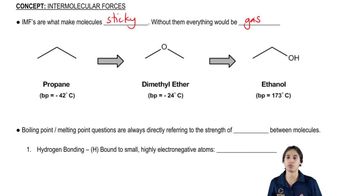
How IMFs are related to melting and boiling points.

Branching in Alkanes

The structure of a molecule, particularly branching, significantly affects its boiling point. In alkanes, more branching typically leads to lower boiling points because branched molecules have a more compact shape, reducing surface area and van der Waals interactions compared to their straight-chain counterparts.
Recommended video:
Guided course
02:47
Functionalizing Alkanes

Halogenated Compounds and Polarity

Halogenated compounds, such as alkyl halides, exhibit varying boiling points based on their polarity and intermolecular forces. The presence of halogens increases polarity, which can enhance dipole-dipole interactions, affecting boiling points. Comparing pentyl chloride and isopentyl chloride involves considering both molecular weight and branching effects on their boiling points.
Recommended video:
Guided course
03:45
Halogenation Mechanism