Ch. 4 - Isomers: The Arrangement of Atoms in Space
Bruice - Organic Chemistry 8th Edition
Bruice8th EditionOrganic ChemistryISBN: 9780135213711Not the one you use?Change textbook
Chapter 5, Problem 42

1-Bromo-2-methylcyclopentane has four pairs of diastereomers. Draw the four pairs.

Verified step by step guidance
1
Understand the structure of 1-bromo-2-methylcyclopentane: It is a cyclopentane ring with a bromine atom attached to carbon-1 and a methyl group attached to carbon-2. Both substituents can have different spatial orientations (up or down) relative to the plane of the ring, leading to stereoisomers.
Recognize that the molecule has two stereocenters (carbon-1 and carbon-2). Each stereocenter can independently adopt an R or S configuration, resulting in 2^2 = 4 stereoisomers. These stereoisomers form four pairs of diastereomers.
Draw the four stereoisomers: For each stereoisomer, assign the configurations of the two stereocenters (e.g., (R,R), (R,S), (S,R), and (S,S)). Use wedge-and-dash notation to indicate the spatial orientation of the bromine and methyl groups.
Group the stereoisomers into pairs of diastereomers: Diastereomers are stereoisomers that are not mirror images of each other. For example, (R,R) and (R,S) are diastereomers, as are (S,R) and (S,S).
Verify the relationships between the stereoisomers: Confirm that each pair of diastereomers differs in the configuration of at least one stereocenter but is not a mirror image. This ensures that all four pairs of diastereomers are correctly identified.

Verified video answer for a similar problem:

This video solution was recommended by our tutors as helpful for the problem above.
Video duration:
6m
Was this helpful?

Key Concepts

Here are the essential concepts you must grasp in order to answer the question correctly.

Diastereomers

Diastereomers are stereoisomers that are not mirror images of each other. They occur when a molecule has multiple chiral centers, leading to different spatial arrangements of atoms. Unlike enantiomers, which have identical physical properties except for their interaction with polarized light, diastereomers can have significantly different chemical and physical properties, making their identification and separation important in organic chemistry.
Recommended video:
Guided course
03:44
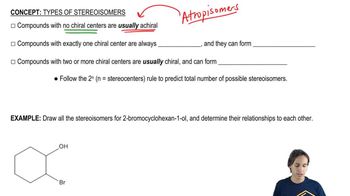
Using chiral centers to predict types of stereoisomers.

Chirality and Chiral Centers

Chirality refers to the geometric property of a molecule having non-superimposable mirror images, often due to the presence of chiral centers, typically carbon atoms bonded to four different substituents. The configuration of these chiral centers can lead to the formation of different stereoisomers, including diastereomers. Understanding chirality is crucial for predicting the behavior and reactivity of organic compounds.
Recommended video:
Guided course
05:10
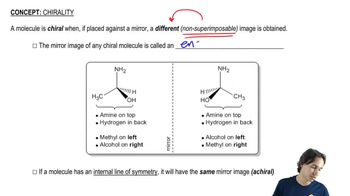
What is chirality?

Drawing Stereoisomers

Drawing stereoisomers involves representing the three-dimensional arrangement of atoms in a molecule on a two-dimensional surface. This includes using wedge and dash notation to indicate bonds that are oriented towards or away from the viewer. For compounds with multiple chiral centers, it is essential to systematically vary the configurations of these centers to illustrate all possible stereoisomers, including diastereomers.
Recommended video:
Guided course
07:41
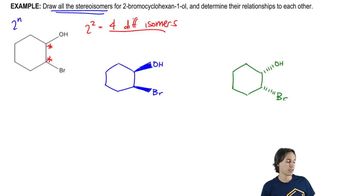
Draw stereoisomers and determine relationship