Ch. 4 - Isomers: The Arrangement of Atoms in Space
Bruice - Organic Chemistry 8th Edition
Bruice8th EditionOrganic ChemistryISBN: 9780135213711Not the one you use?Change textbook
Chapter 5, Problem 17

a. How many asymmetric centers does the following compound have?
b. How many stereocenters does it have?

Verified step by step guidance
1
Step 1: Identify asymmetric centers in the compound. An asymmetric center is a carbon atom bonded to four different groups. In the given structure, examine each carbon atom to determine if it meets this criterion. For example, the second carbon from the left (CHCl group) is bonded to a hydrogen, chlorine, a methyl group (CH3), and a CH=CHCH3 group, making it an asymmetric center.
Step 2: Count the number of asymmetric centers. After identifying all asymmetric centers in the molecule, tally them up. In this case, the second carbon from the left is the only asymmetric center.
Step 3: Identify stereocenters in the compound. A stereocenter is any atom at which the interchange of two groups produces a stereoisomer. This includes asymmetric centers and double bonds with cis/trans (E/Z) isomerism. Examine the double bond in the structure (CH=CH) to determine if it can exhibit E/Z isomerism.
Step 4: Count the number of stereocenters. The double bond (CH=CH) is a stereocenter because it can exhibit E/Z isomerism due to the different groups attached to the carbons involved in the double bond. Combine this with the asymmetric center identified earlier to determine the total number of stereocenters.
Step 5: Summarize the findings. The compound has one asymmetric center and two stereocenters (one asymmetric center and one double bond capable of E/Z isomerism).

Verified video answer for a similar problem:

This video solution was recommended by our tutors as helpful for the problem above.
Video duration:
4m
Was this helpful?

Key Concepts

Here are the essential concepts you must grasp in order to answer the question correctly.

Asymmetric Centers

Asymmetric centers, or chiral centers, are carbon atoms that are bonded to four different substituents, leading to non-superimposable mirror images known as enantiomers. Identifying these centers is crucial for determining the stereochemistry of a compound, as they contribute to the molecule's optical activity and overall chirality.
Recommended video:
Guided course
03:38
How to add to asymmetrical double bonds.

Stereocenters

Stereocenters are atoms in a molecule that can give rise to stereoisomerism, which includes both chiral centers and other types of stereogenic elements, such as double bonds with restricted rotation. While all asymmetric centers are stereocenters, not all stereocenters are asymmetric; thus, understanding the distinction is important for analyzing molecular structure.
Recommended video:
Guided course
02:15
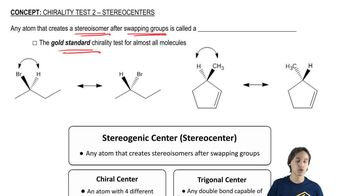
What is a stereocenter?

Stereoisomerism

Stereoisomerism refers to the phenomenon where compounds have the same molecular formula and connectivity of atoms but differ in the spatial arrangement of their atoms. This concept is essential for understanding how different configurations of a molecule can lead to distinct physical and chemical properties, impacting reactivity and interactions in biological systems.
Recommended video:
Guided course
01:58
Determining when molecules are stereoisomers.