Ch. 4 - Isomers: The Arrangement of Atoms in Space
Bruice - Organic Chemistry 8th Edition
Bruice8th EditionOrganic ChemistryISBN: 9780135213711Not the one you use?Change textbook
Chapter 5, Problem 22a,b

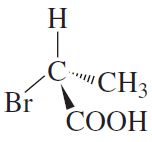
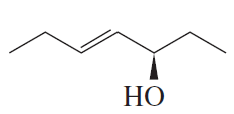
Do the following compounds have the R or the S configuration?
a. Structural formula of a chiral carbon atom with attached groups: H, Br, CH3, and COOH, indicating R or S configuration.
b. Chemical structure showing a compound with a hydroxyl group (HO) for R and S configuration analysis.

Verified step by step guidance
1
Step 1: Identify the chiral center in each compound. For compound A, the chiral center is the carbon atom bonded to Cl, H, CHO, and CH3. For compound B, the chiral center is the carbon atom bonded to Br, H, and the two carbon chains.
Step 2: Assign priorities to the substituents attached to the chiral center based on the Cahn-Ingold-Prelog priority rules. Higher atomic numbers take precedence. For compound A, Cl has the highest priority (1), followed by CHO (2), CH3 (3), and H (4). For compound B, Br has the highest priority (1), followed by the longer carbon chain (2), the shorter carbon chain (3), and H (4).
Step 3: Orient the molecule so that the lowest priority group (H) is pointing away from you. For compound A, H is already on the dashed wedge, indicating it is pointing away. For compound B, H is also on the dashed wedge, indicating it is pointing away.
Step 4: Determine the order of the remaining substituents (1 → 2 → 3) as you look at the molecule. For compound A, trace the path from Cl (1) to CHO (2) to CH3 (3). For compound B, trace the path from Br (1) to the longer chain (2) to the shorter chain (3).
Step 5: If the path traced is clockwise, the configuration is R. If the path traced is counterclockwise, the configuration is S. Analyze the direction of the path for each compound to determine the configuration.

Verified video answer for a similar problem:

This video solution was recommended by our tutors as helpful for the problem above.
Video duration:
7m
Was this helpful?

Key Concepts

Here are the essential concepts you must grasp in order to answer the question correctly.

Cahn-Ingold-Prelog Priority Rules

The Cahn-Ingold-Prelog (CIP) priority rules are used to assign priorities to the substituents attached to a chiral center based on atomic number and connectivity. The higher the atomic number of the atom directly bonded to the chiral center, the higher the priority. If two substituents have the same atom, the next atoms in the chain are considered until a difference is found.

R and S Configuration

The R and S configuration designations are used to describe the spatial arrangement of substituents around a chiral center. After assigning priorities to the substituents, if the sequence from highest to lowest priority is clockwise, the configuration is R (rectus); if counterclockwise, it is S (sinister). This system helps in distinguishing between different stereoisomers.

Chirality and Stereoisomerism

Chirality refers to the property of a molecule that makes it non-superimposable on its mirror image, often due to the presence of a chiral center, typically a carbon atom bonded to four different substituents. Stereoisomerism arises when molecules have the same molecular formula but differ in the arrangement of atoms in space, leading to distinct physical and chemical properties.