Ch. 4 - Isomers: The Arrangement of Atoms in Space
Bruice - Organic Chemistry 8th Edition
Bruice8th EditionOrganic ChemistryISBN: 9780135213711Not the one you use?Change textbook
Chapter 5, Problem 2a

Draw the cis and trans isomers for the following:
a. 1-bromo-4-chlorocyclohexane

Verified step by step guidance
1
Understand the structure of cyclohexane: Cyclohexane is a six-membered ring that can adopt a chair conformation. Substituents on the ring can occupy either axial (perpendicular to the ring plane) or equatorial (parallel to the ring plane) positions.
Identify the substituents: The molecule has a bromine atom at position 1 and a chlorine atom at position 4. These substituents can be arranged in either a cis (same side of the ring) or trans (opposite sides of the ring) configuration.
Draw the cis isomer: In the cis isomer, both substituents (bromine and chlorine) are on the same side of the cyclohexane ring. For example, both can be in axial positions or both in equatorial positions. Ensure the relative stereochemistry is consistent with the cis configuration.
Draw the trans isomer: In the trans isomer, the substituents are on opposite sides of the cyclohexane ring. For example, one substituent can be in an axial position while the other is in an equatorial position. Ensure the relative stereochemistry is consistent with the trans configuration.
Verify the stereochemistry: Double-check that the drawings correctly represent the cis and trans isomers by confirming the relative positions of the substituents on the ring. Use wedge and dash bonds to indicate the 3D orientation of the substituents if needed.

Verified video answer for a similar problem:

This video solution was recommended by our tutors as helpful for the problem above.
Video duration:
4m
Was this helpful?

Key Concepts

Here are the essential concepts you must grasp in order to answer the question correctly.

Cis-Trans Isomerism

Cis-trans isomerism, also known as geometric isomerism, occurs in compounds with restricted rotation around a double bond or a ring structure. In this type of isomerism, the spatial arrangement of substituents differs, leading to distinct isomers. 'Cis' refers to substituents on the same side, while 'trans' indicates they are on opposite sides, affecting the compound's physical and chemical properties.
Recommended video:
Guided course
00:44
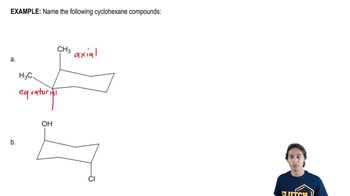
Is the following cyclohexane cis or trans?

Cyclohexane Structure

Cyclohexane is a six-membered carbon ring that can adopt various conformations, primarily the chair and boat forms. The chair conformation is the most stable due to minimized steric strain and torsional strain. Understanding the cyclohexane structure is crucial for visualizing how substituents can be positioned in either a cis or trans arrangement relative to each other.
Recommended video:
Guided course
03:04
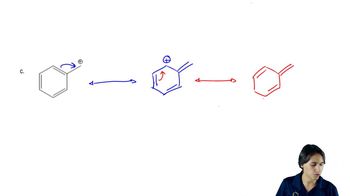
Drawing Resonance Structures

Substituent Positioning

In the context of cyclohexane derivatives, the positioning of substituents (like bromine and chlorine in 1-bromo-4-chlorocyclohexane) is essential for determining the isomer type. When substituents are on the same side of the ring, the compound is a cis isomer; when they are on opposite sides, it is a trans isomer. This positioning influences the molecule's reactivity and interactions with other substances.
Recommended video:
4:06
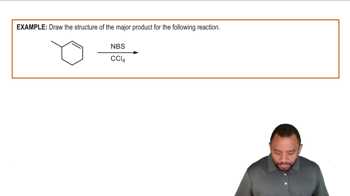
Reactions at the Allylic Position Example 3