Ch. 4 - Isomers: The Arrangement of Atoms in Space
Bruice - Organic Chemistry 8th Edition
Bruice8th EditionOrganic ChemistryISBN: 9780135213711Not the one you use?Change textbook
Chapter 5, Problem 52a

Draw the four stereoisomers of 1,3-dichloro-2-pentanol using
a. Fischer projections.

Verified step by step guidance
1
Step 1: Understand the structure of 1,3-dichloro-2-pentanol. The molecule has a five-carbon chain (pentane backbone) with chlorine atoms attached to carbons 1 and 3, and a hydroxyl (-OH) group attached to carbon 2. Identify the stereocenters in the molecule, which are carbons 1, 2, and 3.
Step 2: Recall that stereoisomers arise due to the different spatial arrangements of substituents around stereocenters. Each stereocenter can have two configurations: R (rectus) or S (sinister). For three stereocenters, there are 2³ = 8 possible stereoisomers, but due to symmetry, only four unique stereoisomers exist.
Step 3: Learn how to draw Fischer projections. In Fischer projections, the vertical lines represent bonds going away from the viewer (into the plane), and the horizontal lines represent bonds coming toward the viewer (out of the plane). Place the longest carbon chain vertically, with the most oxidized group (e.g., -OH) at the top.
Step 4: Assign configurations to the stereocenters. For each stereoisomer, determine the R/S configuration of carbons 1, 2, and 3 based on the Cahn-Ingold-Prelog priority rules. Draw the substituents (Cl, H, OH, and CH₃ groups) accordingly in the Fischer projection format.
Step 5: Draw the four stereoisomers systematically. For example, one stereoisomer might have R configurations at carbons 1 and 3, and an S configuration at carbon 2. Another stereoisomer might have S configurations at carbons 1 and 3, and an R configuration at carbon 2. Repeat this process to generate all four unique stereoisomers in Fischer projection format.

Verified video answer for a similar problem:

This video solution was recommended by our tutors as helpful for the problem above.
Video duration:
4m
Was this helpful?

Key Concepts

Here are the essential concepts you must grasp in order to answer the question correctly.

Stereoisomerism

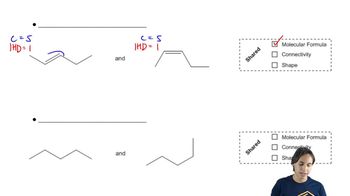
Stereoisomerism refers to the phenomenon where compounds have the same molecular formula and connectivity of atoms but differ in the spatial arrangement of their atoms. This can lead to different physical and chemical properties. In the case of 1,3-dichloro-2-pentanol, stereoisomers arise due to the presence of chiral centers, which can exist in different configurations.
Recommended video:
Guided course
01:58
Determining when molecules are stereoisomers.

Fischer Projections

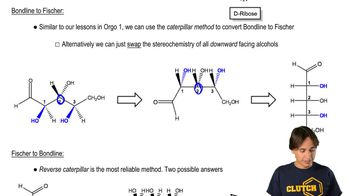
Fischer projections are a two-dimensional representation of three-dimensional organic molecules, particularly useful for depicting stereochemistry. In these projections, vertical lines represent bonds that extend away from the viewer, while horizontal lines represent bonds that come towards the viewer. This format is particularly helpful for visualizing the stereoisomers of compounds with multiple chiral centers.
Recommended video:
Guided course
09:56
Monosaccharides - Drawing Fischer Projections

Chirality and Chiral Centers

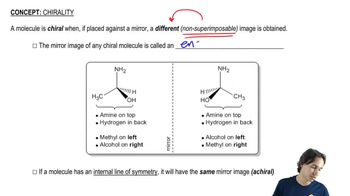
Chirality is a property of a molecule that makes it non-superimposable on its mirror image, often due to the presence of chiral centers—typically carbon atoms bonded to four different substituents. In 1,3-dichloro-2-pentanol, the chiral centers contribute to the formation of stereoisomers, as each configuration can lead to distinct isomers with unique properties.
Recommended video:
Guided course
05:10
What is chirality?