

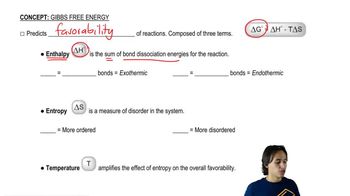
a. For a reaction with ∆H° = -12 kcal/mol and ∆S° = 0.01 kcal mol-1 K-1, calculate the ∆G° and the equilibrium constant at:
1. 30 °C and 2. 150 °C.
b. How does ∆G° change as T increases?
c. How does Keq change as T increases?
Bruice 8th Edition
Ch. 5 - Alkenes: Structure, Nomenclature, and an Introduction to Reactivity • Thermodynamics and Kinetics
Problem 20a
Verified step by step guidance
a. For a reaction with ∆H° = -12 kcal/mol and ∆S° = 0.01 kcal mol-1 K-1, calculate the ∆G° and the equilibrium constant at:
1. 30 °C and 2. 150 °C.
b. How does ∆G° change as T increases?
c. How does Keq change as T increases?
For each of the reactions in Problem 15, indicate which reactant is the nucleophile and which is the electrophile.
a.
b.
Calculate ∆G° for the conversion of “axial” methylcyclohexane to “equatorial” methylcyclohexane at 25 °C.
Why is the percentage of molecules with the substituent in an equatorial position greater for isopropylcyclohexane than for fluorocyclohexane?
The ∆G° for conversion of “axial” fluorocyclohexane to “equatorial” fluorocyclohexane at 25 °C is -0.25kcal/mol. Calculate the percentage of fluorocyclohexane molecules that have the fluoro substituent in an equatorial position at equilibrium.
a. For which reaction in each set will ∆S° be more significant?
b. For which reaction will ∆S° be positive?
1. A ⇌ B or A + B ⇌ C
2. A ⇌ B + C or A + B ⇌ C + D