Ch. 5 - Alkenes: Structure, Nomenclature, and an Introduction to Reactivity • Thermodynamics and Kinetics
Bruice - Organic Chemistry 8th Edition
Bruice8th EditionOrganic ChemistryISBN: 9780135213711Not the one you use?Change textbook
Chapter 6, Problem 35

Draw a reaction coordinate diagram for a two-step reaction in which the first step is endergonic, the second step is exergonic, and the overall reaction is endergonic. Label the reactants, products, intermediates, and transition states.

Verified step by step guidance
1
Start by understanding the reaction coordinate diagram: It is a graph where the x-axis represents the reaction progress (from reactants to products) and the y-axis represents the potential energy of the system. The diagram visually represents the energy changes during the reaction.
Identify the key features of the reaction: Since the first step is endergonic, it means the energy of the intermediate formed after the first step is higher than the energy of the reactants. The second step is exergonic, meaning the energy of the products formed in this step is lower than the intermediate. However, the overall reaction is endergonic, so the energy of the products is higher than the reactants.
Draw the reactants at a lower energy level on the left side of the diagram. Then, draw the first transition state as a peak higher than the reactants, representing the energy barrier for the first step. After the peak, draw the intermediate at a higher energy level than the reactants, as the first step is endergonic.
For the second step, draw the second transition state as another peak, but this time lower than the first transition state, representing the energy barrier for the exergonic step. After the second peak, draw the products at a higher energy level than the reactants but lower than the intermediate, as the overall reaction is endergonic.
Label all components clearly: Mark the reactants, products, intermediates, and transition states on the diagram. Ensure the energy levels and peaks are consistent with the energy changes described (endergonic and exergonic steps).

Verified video answer for a similar problem:

This video solution was recommended by our tutors as helpful for the problem above.
Video duration:
1m
Was this helpful?

Key Concepts

Here are the essential concepts you must grasp in order to answer the question correctly.

Reaction Coordinate Diagram

A reaction coordinate diagram visually represents the energy changes during a chemical reaction. The x-axis typically shows the progress of the reaction, while the y-axis indicates the energy level. Key features include reactants, products, intermediates, and transition states, which help illustrate the energy barriers and overall energy changes throughout the reaction.
Recommended video:
Guided course
05:02
Coordination Complexes

Endergonic and Exergonic Reactions

Endergonic reactions require an input of energy to proceed, resulting in products that have higher energy than the reactants. In contrast, exergonic reactions release energy, leading to products with lower energy than the reactants. Understanding these concepts is crucial for analyzing the energy profile of a reaction and determining its spontaneity based on Gibbs free energy changes.
Recommended video:
Guided course
05:09
Heck Reaction

Transition States and Intermediates

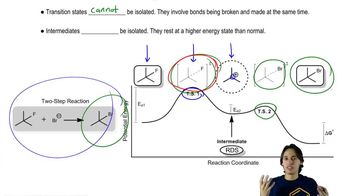
Transition states are high-energy, unstable configurations that occur during the transformation from reactants to products. They represent the peak of the energy barrier that must be overcome for a reaction to proceed. Intermediates, on the other hand, are more stable species formed during the reaction that exist between the transition states. Identifying these elements is essential for constructing an accurate reaction coordinate diagram.
Recommended video:
Guided course
06:55
Intermediates vs. Transition States
Related Practice
Textbook Question

From the Arrhenius equation, predict how

b. increasing the temperature affects the rate constant for a reaction.

1119
views

Textbook Question

From the Arrhenius equation, predict how

a. increasing the experimental activation energy affects the rate constant for a reaction.

1152
views
Textbook Question

Draw a reaction coordinate diagram for the following reaction in which C is the most stable and B the least stable of the three species and the transition state going from A to B is more stable than the transition state going from B to C:

a. How many intermediates are there?

b. How many transition states are there?

c. Which step has the greater rate constant in the forward direction?

d. Which step has the greater rate constant in the reverse direction?

3912
views
Textbook Question

a. Which step in the reaction coordinate diagram shown here has the greatest free energy of activation in the forward direction?

b. Is the first-formed intermediate more apt to revert to reactants or go on to form products?

c. Which step is the rate-determining step of the reaction?

<IMAGE>

2091
views
2
rank
Textbook Question

Which of the following parameters would be different for a reaction carried out in the presence of a catalyst compared with the same reaction carried out in the absence of a catalyst?

G°, ∆H, Ea, ∆S, ∆H°, Keq, ∆G, ∆S°, k

1160
views
Textbook Question

a. Which reaction has a greater equilibrium constant: one with a rate constant of 1 × 10⁻³ sec-1 for the forward reaction and a rate constant of 1 × 10⁻⁵ sec-1 for the reverse reaction, or one with a rate constant of 1 × 10⁻² sec-1 for the forward reaction and a rate constant of 1 × 10⁻³ sec-1 for the reverse reaction?

b. If both reactions start with a reactant concentration of 1.0 M, which reaction will form the most product when the reactions have reached equilibrium?

1664
views