Ch. 5 - Alkenes: Structure, Nomenclature, and an Introduction to Reactivity • Thermodynamics and Kinetics
Bruice - Organic Chemistry 8th Edition
Bruice8th EditionOrganic ChemistryISBN: 9780135213711Not the one you use?Change textbook
Chapter 6, Problem 9a,b

Draw the structure for each of the following:
a. 3,3-dimethylcyclopentene
b. 6-bromo-2,3-dimethyl-2-hexene

Verified step by step guidance
1
Step 1: For part (a), start by identifying the parent structure. The parent structure is 'cyclopentene,' which is a five-membered ring containing one double bond. Draw a cyclopentene ring with one double bond in the structure.
Step 2: Add the substituents to the cyclopentene ring. The name '3,3-dimethyl' indicates that there are two methyl groups attached to the third carbon of the cyclopentene ring. Number the ring carbons such that the double bond gets the lowest possible number (1 and 2). Place the two methyl groups on carbon 3.
Step 3: For part (b), identify the parent structure. The parent structure is '2-hexene,' which is a six-carbon chain with a double bond between carbons 2 and 3. Draw a six-carbon chain and place a double bond between carbons 2 and 3.
Step 4: Add the substituents to the hexene chain. The name '6-bromo' indicates a bromine atom attached to carbon 6, and '2,3-dimethyl' indicates methyl groups attached to carbons 2 and 3. Number the chain such that the double bond gets the lowest possible number (2). Place the bromine atom on carbon 6 and the methyl groups on carbons 2 and 3.
Step 5: Verify the structures for both parts (a) and (b) to ensure that all substituents are correctly placed, the double bonds are in the correct positions, and the structures follow the IUPAC naming conventions.

Verified video answer for a similar problem:

This video solution was recommended by our tutors as helpful for the problem above.
Video duration:
3m
Was this helpful?

Key Concepts

Here are the essential concepts you must grasp in order to answer the question correctly.

Cycloalkenes

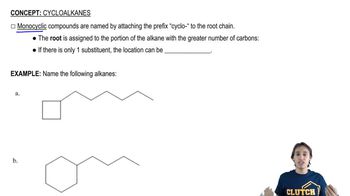
Cycloalkenes are cyclic hydrocarbons that contain at least one carbon-carbon double bond. In the case of 3,3-dimethylcyclopentene, the structure consists of a five-membered carbon ring with two methyl groups attached to the third carbon. Understanding the geometry and bonding in cycloalkenes is crucial for accurately drawing their structures.
Recommended video:
Guided course
01:11
How to find the root name for cycloalkanes

Substituent Positioning

In organic chemistry, the positioning of substituents on a carbon chain or ring is essential for defining the compound's structure and properties. For 6-bromo-2,3-dimethyl-2-hexene, the numbers indicate the specific locations of the bromine and methyl groups on the hexene chain, which is a six-carbon alkene. Correctly identifying these positions is vital for drawing the accurate molecular structure.
Recommended video:
4:06
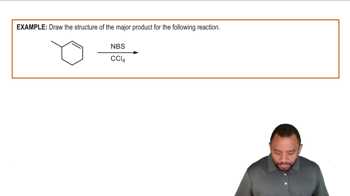
Reactions at the Allylic Position Example 3

Double Bonds and Stereochemistry

Double bonds in alkenes introduce geometric isomerism due to restricted rotation around the bond. In 6-bromo-2,3-dimethyl-2-hexene, the presence of the double bond at the second carbon can lead to cis/trans isomerism, affecting the compound's physical and chemical properties. Recognizing the implications of double bonds and their stereochemistry is important for understanding the overall structure.
Recommended video:
1:38
Polymer Stereochemistry Concept 1