Ch. 5 - Alkenes: Structure, Nomenclature, and an Introduction to Reactivity • Thermodynamics and Kinetics
Bruice - Organic Chemistry 8th Edition
Bruice8th EditionOrganic ChemistryISBN: 9780135213711Not the one you use?Change textbook
Chapter 6, Problem 50a,b

In a reaction in which reactant A is in equilibrium with product B at 25 °C, what relative amounts of A and B are present at equilibrium if ∆G° at 25 °C is
a. 2.72 kcal/mol?
b. 0.65 kcal/mol?

Verified step by step guidance
1
Understand the relationship between the Gibbs free energy change (∆G°) and the equilibrium constant (K) using the equation: ∆G° = -RT ln(K), where R is the gas constant (1.987 cal/(mol·K)) and T is the temperature in Kelvin (25 °C = 298 K).
Rearrange the equation to solve for the equilibrium constant (K): K = e^(-∆G°/(RT)). This will allow you to calculate the ratio of products (B) to reactants (A) at equilibrium.
Substitute the given values of ∆G° (2.72 kcal/mol and 0.65 kcal/mol) into the equation. Remember to convert ∆G° from kcal/mol to cal/mol by multiplying by 1000 (e.g., 2.72 kcal/mol = 2720 cal/mol).
For each case, calculate the value of K using the rearranged equation. This will give you the equilibrium constant, which represents the ratio of the concentration of B to A at equilibrium: K = [B]/[A].
Interpret the results: If K > 1, product B is favored at equilibrium. If K < 1, reactant A is favored. Use the calculated K values to determine the relative amounts of A and B for each case.

Verified video answer for a similar problem:

This video solution was recommended by our tutors as helpful for the problem above.
Video duration:
5m
Was this helpful?

Key Concepts

Here are the essential concepts you must grasp in order to answer the question correctly.

Gibbs Free Energy (∆G)

Gibbs Free Energy (∆G) is a thermodynamic potential that measures the maximum reversible work obtainable from a thermodynamic system at constant temperature and pressure. It indicates the spontaneity of a reaction; a negative ∆G suggests that the reaction proceeds forward, while a positive ∆G indicates that the reaction is non-spontaneous. The standard Gibbs free energy change (∆G°) at a specific temperature helps predict the equilibrium position of a reaction.
Recommended video:
Guided course
05:02
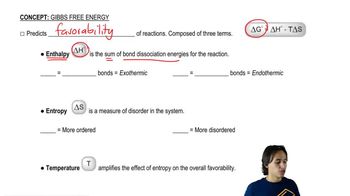
Breaking down the different terms of the Gibbs Free Energy equation.

Equilibrium Constant (K)

The equilibrium constant (K) is a dimensionless value that expresses the ratio of the concentrations of products to reactants at equilibrium for a given reaction at a specific temperature. It is derived from the Gibbs free energy change, where a negative ∆G° corresponds to a K value greater than 1, favoring products, while a positive ∆G° corresponds to a K value less than 1, favoring reactants. Understanding K is essential for determining the relative amounts of A and B at equilibrium.
Recommended video:
Guided course
02:19
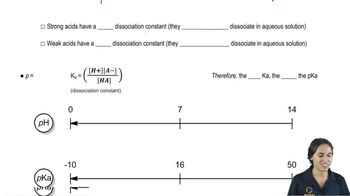
The relationship between equilibrium constant and pKa.

Relationship between ∆G° and K

The relationship between standard Gibbs free energy change (∆G°) and the equilibrium constant (K) is given by the equation ∆G° = -RT ln(K), where R is the universal gas constant and T is the temperature in Kelvin. This equation allows us to calculate K from ∆G° and vice versa. By knowing the value of ∆G° at 25 °C, we can determine the relative concentrations of reactants and products at equilibrium, which is crucial for answering the question.
Recommended video:
Guided course
01:40
Same atoms, same connectivity, 1 chiral center.