Ch. 6 - The Reactions of Alkenes • The Stereochemistry of Addition Reactions
Bruice - Organic Chemistry 8th Edition
Bruice8th EditionOrganic ChemistryISBN: 9780135213711Not the one you use?Change textbook
Chapter 7, Problem 96

a. Propose a mechanism for the following reaction:
Chemical reaction diagram showing hydrohalogenation with reactants and products, including a bromine atom.
b. Is the initially formed carbocation primary, secondary, or tertiary?
c. Is the rearranged carbocation primary, secondary, or tertiary?
d. Why does the rearrangement occur?

Verified step by step guidance
1
Step 1: Analyze the reaction. The starting material is an alkene, and the reagent is HBr. This indicates that the reaction is an electrophilic addition of HBr to the alkene. The alkene will act as a nucleophile, attacking the proton (H⁺) from HBr, leading to the formation of a carbocation intermediate.
Step 2: Determine the initially formed carbocation. When the alkene attacks H⁺, the double bond breaks, and the positive charge is placed on the carbon that can best stabilize the carbocation. In this case, the initially formed carbocation is secondary because the positive charge is on a carbon attached to two other carbons.
Step 3: Consider carbocation rearrangement. Carbocations can undergo rearrangement to form a more stable carbocation. In this case, a hydride shift occurs, moving a hydrogen atom (along with its bonding electrons) from a neighboring carbon to the carbocation center. This results in the formation of a tertiary carbocation, which is more stable due to increased hyperconjugation and inductive effects.
Step 4: Explain why the rearrangement occurs. The rearrangement occurs because tertiary carbocations are more stable than secondary carbocations. Stability increases due to the greater number of alkyl groups donating electron density through hyperconjugation and inductive effects, stabilizing the positive charge.
Step 5: Complete the reaction mechanism. After the rearrangement, the bromide ion (Br⁻) attacks the tertiary carbocation, forming the final product. The major product is the one where Br⁻ adds to the more stable tertiary carbocation, while the minor product results from Br⁻ adding to the secondary carbocation before rearrangement.

Verified video answer for a similar problem:

This video solution was recommended by our tutors as helpful for the problem above.
Video duration:
9m
Was this helpful?

Key Concepts

Here are the essential concepts you must grasp in order to answer the question correctly.

Hydrohalogenation

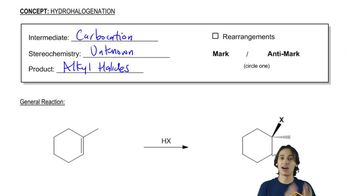
Hydrohalogenation is an electrophilic addition reaction where a hydrogen halide (like HBr) adds across a double bond in an alkene. The reaction typically involves the formation of a carbocation intermediate, where the more stable carbocation is favored. This process is crucial for understanding how the halogen and hydrogen are added to the alkene, influencing the final product's structure.
Recommended video:
Guided course
04:07
General properties of hydrohalogenation.

Carbocation Stability

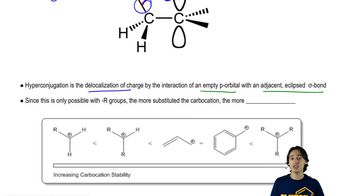
Carbocation stability is determined by the degree of alkyl substitution around the positively charged carbon atom. Tertiary carbocations are the most stable due to hyperconjugation and inductive effects from surrounding alkyl groups, followed by secondary and primary carbocations. Recognizing the stability of the initially formed and rearranged carbocations is essential for predicting the major product of the reaction.
Recommended video:
Guided course
05:58
Determining Carbocation Stability

Carbocation Rearrangement

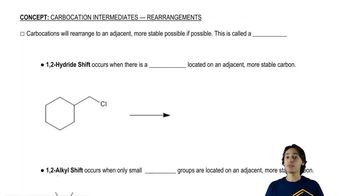
Carbocation rearrangement occurs when a less stable carbocation transforms into a more stable one, often through hydride or alkyl shifts. This process is driven by the stability of the resulting carbocation, which can lead to different products. Understanding why and how rearrangements happen is key to predicting the outcome of reactions involving carbocations, such as in hydrohalogenation.
Recommended video:
Guided course
00:47
Understanding why carbocations shift.