Ch. 6 - The Reactions of Alkenes • The Stereochemistry of Addition Reactions
Bruice - Organic Chemistry 8th Edition
Bruice8th EditionOrganic ChemistryISBN: 9780135213711Not the one you use?Change textbook
Chapter 7, Problem 92b

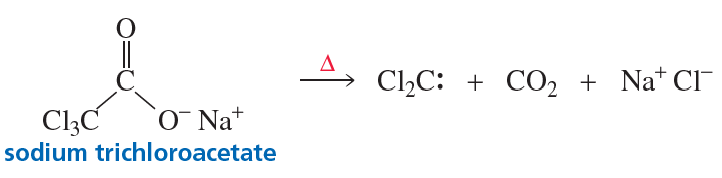
Dichlorocarbene can also be generated by heating sodium trichloroacetate. Propose a mechanism for the reaction.
Reaction mechanism showing sodium trichloroacetate converting to dichlorocarbene, carbon dioxide, and sodium chloride.

Verified step by step guidance
1
Step 1: Begin by identifying the starting material, sodium trichloroacetate (NaO−CCl3). This compound contains a trichloromethyl group attached to a carboxylate functional group.
Step 2: Upon heating, the carboxylate group undergoes decarboxylation. This process involves the loss of carbon dioxide (CO2), which is facilitated by the thermal energy provided.
Step 3: The decarboxylation results in the formation of a trichloromethyl anion (CCl3−). This intermediate is highly unstable and undergoes further reaction.
Step 4: The trichloromethyl anion (CCl3−) eliminates a chloride ion (Cl−), leading to the generation of dichlorocarbene (:CCl2). Dichlorocarbene is a reactive intermediate with a divalent carbon atom and two lone pairs.
Step 5: The final products of the reaction are dichlorocarbene (:CCl2), carbon dioxide (CO2), and sodium chloride (NaCl). The mechanism highlights the thermal decomposition and rearrangement steps leading to the formation of these products.

Verified video answer for a similar problem:

This video solution was recommended by our tutors as helpful for the problem above.
Video duration:
3m
Was this helpful?

Key Concepts

Here are the essential concepts you must grasp in order to answer the question correctly.

Dichlorocarbene Generation

Dichlorocarbene (Br2C:) is a reactive intermediate formed during certain organic reactions. It can be generated from precursors like sodium trichloroacetate through thermal decomposition. The process involves the loss of carbon dioxide (CO2) and the formation of the dichlorocarbene species, which is crucial for various synthetic applications in organic chemistry.
Recommended video:
Guided course
04:10
Overview of Cross-Coupling General Reactions

Thermal Decomposition

Thermal decomposition is a chemical reaction where a compound breaks down into simpler substances when heated. In the context of sodium trichloroacetate, heating induces the cleavage of bonds, leading to the release of CO2 and the formation of dichlorocarbene. Understanding this concept is essential for predicting the products of reactions involving heat.
Recommended video:
Guided course
06:36
MO Theory of Thermal Electrocyclics

Mechanism of Reaction

A reaction mechanism describes the step-by-step sequence of elementary reactions by which overall chemical change occurs. For the generation of dichlorocarbene from sodium trichloroacetate, the mechanism involves bond breaking and formation, which can be illustrated through curved arrows in reaction diagrams. Analyzing the mechanism helps in understanding the stability and reactivity of intermediates.
Recommended video:
Guided course
02:16
Heck Reaction Mechanism