Ch. 6 - The Reactions of Alkenes • The Stereochemistry of Addition Reactions
Bruice - Organic Chemistry 8th Edition
Bruice8th EditionOrganic ChemistryISBN: 9780135213711Not the one you use?Change textbook
Chapter 7, Problem 74b

Draw the products of the following reactions. If the products can exist as stereoisomers, show which stereoisomers are formed.
b. Chemical reaction showing the addition of water to an alkene with sulfuric acid as a catalyst, producing stereoisomers.

Verified step by step guidance
1
Step 1: Identify the type of reaction. The given reaction involves an alkene reacting with water in the presence of sulfuric acid (H2SO4). This is an example of an acid-catalyzed hydration reaction, which adds water (H and OH) across the double bond of the alkene.
Step 2: Determine the regioselectivity of the reaction. According to Markovnikov's rule, the hydrogen atom (H) will add to the carbon of the double bond that has more hydrogens, and the hydroxyl group (OH) will add to the carbon with fewer hydrogens.
Step 3: Analyze the structure of the alkene. The double bond is located between two carbons: one is tertiary (connected to three other carbons) and the other is secondary (connected to two other carbons). The OH group will add to the tertiary carbon because it is more stable due to hyperconjugation and inductive effects.
Step 4: Consider stereochemistry. If the product can form chiral centers, you need to show the stereoisomers. In this case, the addition of H and OH across the double bond can lead to the formation of a chiral center at the tertiary carbon. Both R and S configurations should be shown if applicable.
Step 5: Draw the product. The final product will be an alcohol with the OH group attached to the tertiary carbon and the H attached to the secondary carbon. Ensure that you represent any stereoisomers formed due to the creation of a chiral center.

Verified video answer for a similar problem:

This video solution was recommended by our tutors as helpful for the problem above.
Video duration:
3m
Was this helpful?

Key Concepts

Here are the essential concepts you must grasp in order to answer the question correctly.

Acid-Catalyzed Hydration

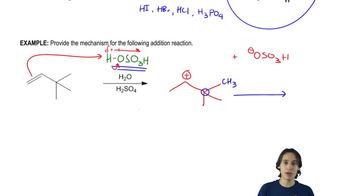
Acid-catalyzed hydration is a reaction where an alkene reacts with water in the presence of an acid catalyst, typically sulfuric acid (H2SO4). The acid protonates the alkene, forming a more stable carbocation intermediate, which then reacts with water to form an alcohol. This process is crucial for converting alkenes into alcohols and understanding the regioselectivity of the reaction.
Recommended video:
Guided course
06:34
Acid-catalyzed hydration mechanism

Carbocation Stability

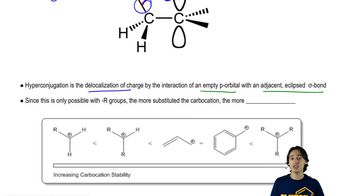
Carbocation stability is a key concept in organic chemistry that refers to the relative stability of positively charged carbon species. Carbocations are stabilized by alkyl groups through hyperconjugation and inductive effects. The more substituted the carbocation (tertiary > secondary > primary), the more stable it is, which influences the product distribution in reactions involving carbocations, such as acid-catalyzed hydration.
Recommended video:
Guided course
05:58
Determining Carbocation Stability

Stereoisomerism

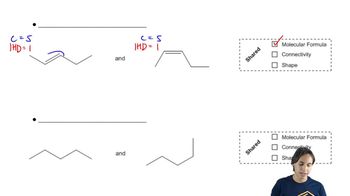
Stereoisomerism occurs when compounds have the same molecular formula and connectivity but differ in the spatial arrangement of atoms. In the context of hydration reactions, the formation of stereoisomers can arise from the addition of water across a double bond, leading to chiral centers. Understanding stereoisomerism is essential for predicting the types of products formed, including enantiomers and diastereomers, in reactions involving chiral intermediates.
Recommended video:
Guided course
01:58
Determining when molecules are stereoisomers.
Related Practice
Textbook Question

Draw the products of the following reactions. If the products can exist as stereoisomers, show which stereoisomers are formed.

c.

1334
views

Textbook Question

a. Draw the product or products that will be obtained from the reaction of cis-2-butene and trans-2-butene with each of the following reagents. If a product can exist as stereoisomers, show which stereoisomers are formed.

7. H2O + H2SO4

b. With which reagents do the two alkenes react to form different products?

1315
views
Textbook Question

A student was about to turn in the products he had obtained from the reaction of HI with 3,3,3-trifluoropropene when he realized that the labels had fallen off his flasks and he did not know which label belonged to which flask. His friend reminded him of the rule that says the electrophile adds to the sp2 carbon bonded to the most hydrogens. In other words, he should label the flask containing the most product 1,1,1-trifluoro-2-iodopropane and label the flask containing the least amount of product 1,1,1-trifluoro-3-iodopropane. Should he follow his friend’s advice?

1045
views
Textbook Question

a. Propose a mechanism for the following reaction (show all curved arrows):

1005
views
Textbook Question

The second-order rate constant (in units of M-1s-1) for acid-catalyzed hydration at 25 °C is given for each of the following alkenes:

a. Calculate the relative rates of hydration of the alkenes. (Hint: Divide each rate constant by the smallest rate constant of the series: 3.51 × 10⁻⁸.)

b. Why does (Z)-2-butene react faster than (E)-2-butene?

c. Why does 2-methyl-2-butene react faster than (Z)-2-butene?

d. Why does 2,3-dimethyl-2-butene react faster than 2-methyl-2-butene?

1621
views
Textbook Question

1-Methylcyclohexene forms two products when it reacts with bromine in methanol.

a. Draw the mechanism for the formation of the products.

b. Describe their stereochemical relationship—that is, are they enantiomers or diastereomers?

2019
views