Ch. 6 - The Reactions of Alkenes • The Stereochemistry of Addition Reactions
Bruice - Organic Chemistry 8th Edition
Bruice8th EditionOrganic ChemistryISBN: 9780135213711Not the one you use?Change textbook
Chapter 7, Problem 82c

Draw the products of the following reactions. If the products can exist as stereoisomers, show which stereoisomers are formed
c. 1-ethylcyclohexene + H2O + H2SO4

Verified step by step guidance
1
Step 1: Recognize the reaction type. This is an acid-catalyzed hydration reaction where H2SO4 acts as the catalyst and H2O provides the nucleophile. The reaction follows Markovnikov's rule, meaning the OH group will add to the more substituted carbon of the double bond.
Step 2: Protonation of the alkene. The double bond in 1-ethylcyclohexene will react with H⁺ (from H2SO4), forming a carbocation intermediate. The proton will add to the less substituted carbon of the double bond, resulting in a carbocation at the more substituted carbon.
Step 3: Consider carbocation stability. The carbocation formed at the more substituted carbon is stable due to hyperconjugation and inductive effects. No rearrangement is expected in this case.
Step 4: Nucleophilic attack by water. The lone pair of electrons on the oxygen atom in H2O will attack the carbocation, forming an oxonium ion intermediate.
Step 5: Deprotonation of the oxonium ion. A base (likely HSO4⁻) will remove a proton from the oxonium ion, resulting in the formation of the alcohol product. The product will be 1-ethylcyclohexanol, and since the addition of water is not stereospecific, both stereoisomers (R and S configurations) of the alcohol can be formed.

Verified video answer for a similar problem:

This video solution was recommended by our tutors as helpful for the problem above.
Video duration:
3m
Was this helpful?

Key Concepts

Here are the essential concepts you must grasp in order to answer the question correctly.

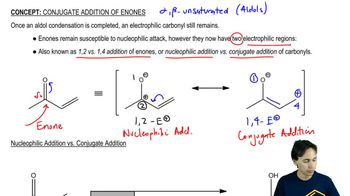
Electrophilic Addition

Electrophilic addition is a fundamental reaction mechanism in organic chemistry where an electrophile reacts with a nucleophile, leading to the formation of a new bond. In this case, the double bond in 1-ethylcyclohexene acts as a nucleophile, attacking the electrophile, which is the proton from sulfuric acid (H2SO4). This reaction typically results in the formation of carbocations, which are key intermediates in the process.
Recommended video:
Guided course
09:23
1,2 vs 1,4 Addition

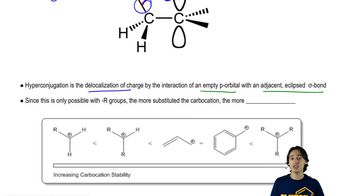
Carbocation Stability

Carbocation stability is crucial in determining the outcome of electrophilic addition reactions. Carbocations are positively charged species that can vary in stability based on their structure; tertiary carbocations are more stable than secondary or primary ones due to hyperconjugation and inductive effects. In the reaction of 1-ethylcyclohexene, the formation of a more stable carbocation will influence the regioselectivity of the addition of water.
Recommended video:
Guided course
05:58
Determining Carbocation Stability

Stereoisomerism

Stereoisomerism refers to the phenomenon where compounds have the same molecular formula and connectivity but differ in the spatial arrangement of atoms. In the context of the reaction, the addition of water to the carbocation can lead to the formation of stereoisomers, particularly if the carbocation is chiral. Understanding how to depict and differentiate these stereoisomers is essential for accurately representing the products of the reaction.
Recommended video:
Guided course
01:58
Determining when molecules are stereoisomers.