
Ch. 6 - The Reactions of Alkenes • The Stereochemistry of Addition Reactions
Bruice - Organic Chemistry 8th Edition
Bruice8th EditionOrganic ChemistryISBN: 9780135213711Not the one you use?Change textbook
Chapter 7, Problem 9a

The pKa of a protonated alcohol is about -2.5, and the pKa of an alcohol is about 15. Therefore, as long as the pH of the solution is greater than _______ and less than _______, more than 50% of 2-propanol (the product of the reaction on p. 244) will be in its neutral, nonprotonated form.

Verified step by step guidance
1
Understand the relationship between pKa, pH, and the protonation state of a molecule. The pKa of a compound is the pH at which 50% of the compound is protonated and 50% is deprotonated. For a protonated alcohol, the pKa is -2.5, and for a neutral alcohol, the pKa is 15.
To determine the pH range where more than 50% of 2-propanol is in its neutral, nonprotonated form, consider the pKa values. If the pH is greater than the pKa of the protonated alcohol (-2.5), the protonated form will deprotonate, favoring the neutral alcohol.
Similarly, if the pH is less than the pKa of the neutral alcohol (15), the neutral alcohol will not lose its proton to form the alkoxide ion. This ensures that the neutral alcohol remains the dominant species.
Combine these observations to establish the pH range. The pH must be greater than -2.5 (to avoid the protonated form) and less than 15 (to avoid the alkoxide form).
Conclude that the pH range where more than 50% of 2-propanol is in its neutral, nonprotonated form is between -2.5 and 15.

Verified video answer for a similar problem:

This video solution was recommended by our tutors as helpful for the problem above.
Video duration:
6m
Was this helpful?

Key Concepts

Here are the essential concepts you must grasp in order to answer the question correctly.

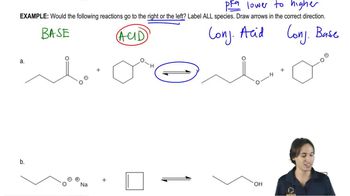
pKa and Acid-Base Equilibrium

pKa is a measure of the strength of an acid in solution, indicating the pH at which half of the acid is dissociated. A lower pKa value signifies a stronger acid. Understanding the relationship between pKa and pH is crucial for predicting the protonation state of compounds in solution, particularly in organic reactions involving alcohols.
Recommended video:
Guided course
04:00
Determining Acid/Base Equilibrium

Protonation and Deprotonation

Protonation refers to the addition of a proton (H+) to a molecule, while deprotonation is the removal of a proton. In the context of alcohols, the protonated form is more acidic and can exist in equilibrium with its neutral form. The pH of the solution determines the predominant form, which is essential for understanding the behavior of 2-propanol in the given reaction.
Recommended video:
Guided course
03:
Proton Splitting

Buffering Capacity and pH Range

The buffering capacity of a solution refers to its ability to resist changes in pH upon the addition of acids or bases. The pH range where a compound exists predominantly in one form can be determined using the pKa values. For 2-propanol, knowing the pKa values allows us to establish the pH range where more than 50% of the compound is in its neutral form, which is critical for predicting reaction outcomes.
Recommended video:
Guided course
02:15
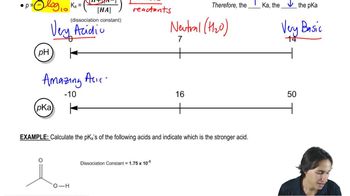
The pH scale vs. the pKa scale.