Ch. 6 - The Reactions of Alkenes • The Stereochemistry of Addition Reactions
Bruice - Organic Chemistry 8th Edition
Bruice8th EditionOrganic ChemistryISBN: 9780135213711Not the one you use?Change textbook
Chapter 7, Problem 67d

Using any alkene and any other reagents, how would you prepare the following compounds?
d.

Verified step by step guidance
1
Step 1: Identify the target molecule's functional groups. The compound contains a bromine (Br) and a hydroxyl group (OH) attached to adjacent carbons, indicating a vicinal halohydrin structure.
Step 2: Choose an appropriate alkene precursor. The target molecule can be synthesized from 2-hexene (CH3CH=CHCH2CH2CH3), as the double bond provides the reactive site for addition reactions.
Step 3: Select reagents for halohydrin formation. Use bromine (Br2) in the presence of water (H2O). This reaction involves electrophilic addition of Br2 to the alkene, followed by nucleophilic attack by water to form the halohydrin.
Step 4: Predict the regioselectivity and stereochemistry. The bromine adds to one carbon of the double bond, and the hydroxyl group adds to the adjacent carbon. The reaction proceeds via anti-addition, resulting in the bromine and hydroxyl group being on opposite sides of the molecule.
Step 5: Verify the product structure. Ensure that the bromine and hydroxyl group are attached to the correct carbons (C3 and C4 in the hexane chain) and that the stereochemistry matches the target molecule.

Verified video answer for a similar problem:

This video solution was recommended by our tutors as helpful for the problem above.
Video duration:
1m
Was this helpful?

Key Concepts

Here are the essential concepts you must grasp in order to answer the question correctly.

Alkene Reactivity

Alkenes are unsaturated hydrocarbons characterized by at least one carbon-carbon double bond. Their reactivity is primarily due to this double bond, which can undergo various reactions such as addition, oxidation, and polymerization. Understanding the types of reactions that alkenes can participate in is crucial for synthesizing target compounds.
Recommended video:
2:09
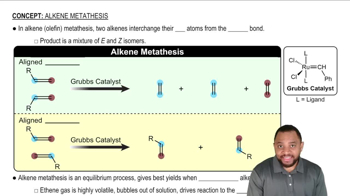
Alkene Metathesis Concept 1

Addition Reactions

Addition reactions involve the addition of atoms or groups to the carbon atoms of the double bond in alkenes, resulting in the formation of saturated compounds. Common addition reactions include hydrogenation, halogenation, and hydrohalogenation. Recognizing the specific reagents and conditions required for these reactions is essential for preparing desired products from alkenes.
Recommended video:
1:42
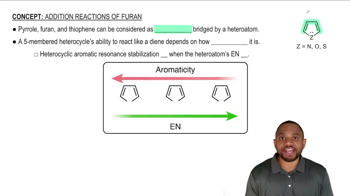
Addition Reactions of Furan Concept 1

Functional Group Transformation

Functional group transformation refers to the process of converting one functional group into another through chemical reactions. This concept is vital in organic synthesis, as it allows chemists to modify the structure and reactivity of molecules. Identifying the appropriate reagents and reaction conditions for transforming functional groups is key to achieving the desired compound from an alkene.
Recommended video:
Guided course
02:36
Identifying Functional Groups