Ch. 6 - The Reactions of Alkenes • The Stereochemistry of Addition Reactions
Bruice - Organic Chemistry 8th Edition
Bruice8th EditionOrganic ChemistryISBN: 9780135213711Not the one you use?Change textbook
Chapter 7, Problem 66e

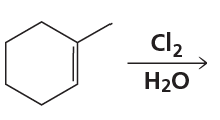
What is the major product of each of the following reactions?
e. Chemical reaction diagram showing a benzene ring reacting with chlorine and water to form a halohydrin product.

Verified step by step guidance
1
Step 1: Analyze the reaction conditions. The reagents are Cl₂ and H₂O, which indicate a halohydrin formation reaction. This reaction typically occurs with alkenes and involves the addition of a halogen and a hydroxyl group across the double bond.
Step 2: Identify the alkene in the given structure. The double bond is located in the cyclopentene ring. This is the reactive site where the halohydrin formation will occur.
Step 3: Understand the mechanism. The reaction proceeds via electrophilic addition. First, Cl₂ interacts with the alkene to form a cyclic chloronium ion intermediate. This intermediate is highly strained and reactive.
Step 4: Water (H₂O) acts as a nucleophile and attacks the more substituted carbon of the chloronium ion, leading to regioselectivity. This results in the hydroxyl group (-OH) attaching to the more substituted carbon and the chlorine atom (-Cl) attaching to the less substituted carbon.
Step 5: Consider stereochemistry. The addition of Cl and OH occurs in an anti fashion (opposite sides of the ring) due to the mechanism of the reaction. The major product will be a halohydrin with anti stereochemistry.

Verified video answer for a similar problem:

This video solution was recommended by our tutors as helpful for the problem above.
Video duration:
6m
Was this helpful?

Key Concepts

Here are the essential concepts you must grasp in order to answer the question correctly.

Electrophilic Addition

Electrophilic addition is a fundamental reaction mechanism in organic chemistry where an electrophile reacts with a nucleophile, typically involving alkenes or alkynes. In this case, the double bond in cyclohexene acts as a nucleophile, attacking the electrophilic chlorine molecule (Cl2), leading to the formation of a cyclic chloronium ion intermediate.
Recommended video:
Guided course
09:23
1,2 vs 1,4 Addition

Regioselectivity

Regioselectivity refers to the preference of a chemical reaction to yield one structural isomer over others when multiple possibilities exist. In the reaction of cyclohexene with Cl2 and H2O, the regioselectivity will determine whether chlorine or hydroxyl (from water) adds to the more substituted or less substituted carbon of the double bond, influencing the major product formed.
Recommended video:
Guided course
05:09
Heck Reaction

Markovnikov's Rule

Markovnikov's Rule states that in the addition of HX to an alkene, the hydrogen atom will attach to the carbon with the greater number of hydrogen atoms already attached, while the halide (or other substituent) will attach to the carbon with fewer hydrogen atoms. This principle helps predict the major product in the reaction of cyclohexene with Cl2 and H2O, guiding the placement of the chlorine and hydroxyl groups.
Recommended video:
Guided course
03:54
The 18 and 16 Electron Rule