Ch. 6 - The Reactions of Alkenes • The Stereochemistry of Addition Reactions
Bruice - Organic Chemistry 8th Edition
Bruice8th EditionOrganic ChemistryISBN: 9780135213711Not the one you use?Change textbook
Chapter 7, Problem 58f

What is the major product of the reaction of 2-methyl-2-butene with each of the following reagents?
f. MCPBA (a peroxyacid)

Verified step by step guidance
1
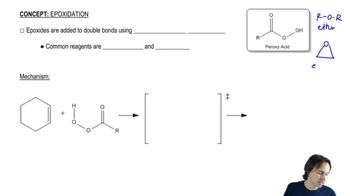
Identify the type of reaction: MCPBA (meta-chloroperoxybenzoic acid) is a peroxyacid commonly used to perform epoxidation of alkenes. This reaction involves the addition of an oxygen atom across the double bond to form an epoxide (a three-membered cyclic ether).
Analyze the structure of the starting material: 2-methyl-2-butene is an alkene with a double bond between the second and third carbons, and a methyl group attached to the second carbon. The double bond is the reactive site for the epoxidation reaction.
Understand the regioselectivity and stereoselectivity: Epoxidation with MCPBA is a concerted reaction, meaning the oxygen atom is added to the double bond in a single step. The reaction is stereospecific, preserving the stereochemistry of the alkene. Since 2-methyl-2-butene is not stereochemically complex (no cis/trans isomers), this step is straightforward.
Draw the product: The oxygen atom from MCPBA will form a three-membered ring (epoxide) with the two carbons of the double bond. The methyl group on the second carbon remains in place, and the overall structure becomes a substituted epoxide.
Verify the major product: Since MCPBA reacts with the double bond in a predictable manner and there are no competing reactions, the major product will be the epoxide derived from 2-methyl-2-butene. Ensure the structure is drawn correctly, showing the three-membered ring and the methyl substituent.

Verified video answer for a similar problem:

This video solution was recommended by our tutors as helpful for the problem above.
Video duration:
2m
Was this helpful?

Key Concepts

Here are the essential concepts you must grasp in order to answer the question correctly.

Electrophilic Addition Reactions

Electrophilic addition reactions involve the addition of electrophiles to alkenes, where the double bond acts as a nucleophile. In the case of 2-methyl-2-butene, the double bond can react with various electrophiles, leading to the formation of more stable carbocations and ultimately the major product of the reaction.
Recommended video:
Guided course
05:39
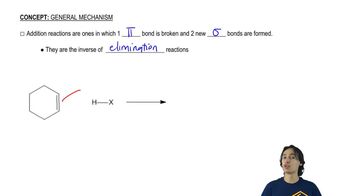
Features of Addition Mechanisms.

Peroxyacids and Epoxidation

Peroxyacids, such as MCPBA, are strong oxidizing agents that can convert alkenes into epoxides through a process called epoxidation. This reaction involves the formation of a three-membered cyclic ether, which is a key intermediate that can lead to various products depending on subsequent reactions.
Recommended video:
Guided course
02:19
General properties of epoxidation.

Regioselectivity and Stereochemistry

Regioselectivity refers to the preference of a chemical reaction to yield one structural isomer over others, while stereochemistry deals with the spatial arrangement of atoms in molecules. In the reaction of 2-methyl-2-butene with MCPBA, understanding these concepts helps predict the major product and its configuration, as the formation of the epoxide can lead to different stereoisomers.
Recommended video:
1:38
Polymer Stereochemistry Concept 1