Ch. 6 - The Reactions of Alkenes • The Stereochemistry of Addition Reactions
Bruice - Organic Chemistry 8th Edition
Bruice8th EditionOrganic ChemistryISBN: 9780135213711Not the one you use?Change textbook
Chapter 7, Problem 64b

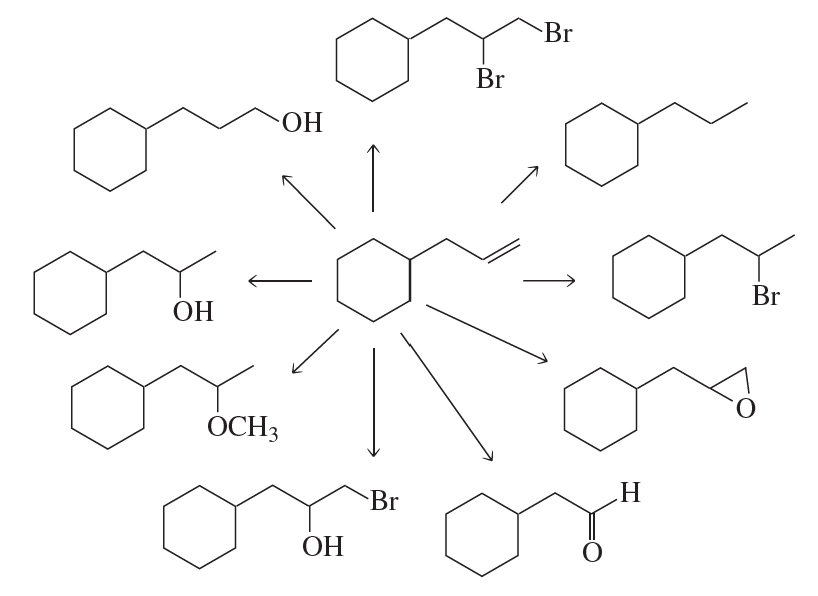
What reagents are needed to carry out the following syntheses?
Diagram illustrating various organic compounds and their reactions, highlighting reagents for syntheses involving bromine.

Verified step by step guidance
1
Step 1: Analyze the first transformation (I). The starting material contains a hydroxyl group (-OH) and a bromine atom (-Br) on adjacent carbons. The product is an alkene, indicating that this is an elimination reaction. To carry out this transformation, a strong base such as potassium tert-butoxide (KOtBu) or sodium ethoxide (NaOEt) can be used to promote E2 elimination.
Step 2: Consider the stereochemistry of the elimination reaction. The base will abstract a proton from the β-carbon (the carbon adjacent to the carbon bearing the leaving group), and the bromine atom will leave as Br⁻. Ensure that the anti-periplanar geometry is satisfied for the elimination to occur.
Step 3: Analyze the second transformation (II). The product contains two bromine atoms on adjacent carbons, indicating that this is a halogenation reaction. The starting material is an alkene, which reacts with molecular bromine (Br₂) in an inert solvent like carbon tetrachloride (CCl₄) to form the dibromo product via an electrophilic addition mechanism.
Step 4: Describe the mechanism of the halogenation reaction. The alkene undergoes electrophilic attack by Br₂, forming a bromonium ion intermediate. This intermediate is then attacked by a bromide ion (Br⁻) to yield the vicinal dibromo compound.
Step 5: Summarize the reagents needed for the syntheses. For the first transformation (I), use a strong base like KOtBu or NaOEt to promote elimination. For the second transformation (II), use Br₂ in CCl₄ to achieve halogenation.

Verified video answer for a similar problem:

This video solution was recommended by our tutors as helpful for the problem above.
Video duration:
7m
Was this helpful?

Key Concepts

Here are the essential concepts you must grasp in order to answer the question correctly.

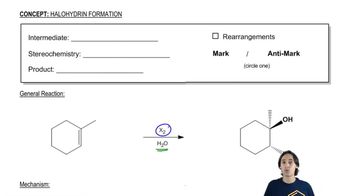
Halohydrin Formation

Halohydrin formation is a reaction where an alkene reacts with a halogen and water to produce a halohydrin, which contains both a halogen and a hydroxyl group. This reaction typically involves the addition of bromine (Br2) followed by water (H2O), leading to the formation of a bromohydrin. Understanding this mechanism is crucial for identifying the reagents needed for the synthesis shown in the question.
Recommended video:
Guided course
01:44
General properties of halohydrin formation.

Reagents in Organic Synthesis

In organic synthesis, reagents are substances used to bring about a chemical reaction. The choice of reagents can significantly influence the outcome of the reaction, including the formation of specific products. For the halohydrin synthesis depicted, the primary reagents are bromine and water, which facilitate the addition of bromine and hydroxyl groups across the double bond of the alkene.
Recommended video:
1:16
Synthesis of Amino Acids: Strecker Synthesis Example 1

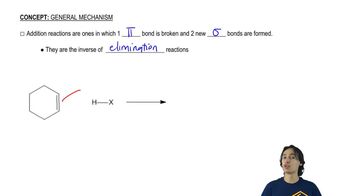
Mechanism of Electrophilic Addition

Electrophilic addition is a fundamental reaction mechanism in organic chemistry where an electrophile reacts with a nucleophile, typically involving alkenes. In the case of halohydrin synthesis, the alkene acts as a nucleophile, attacking the electrophilic bromine molecule, leading to the formation of a cyclic bromonium ion intermediate. This step is essential for understanding how the final products are formed in the reaction.
Recommended video:
Guided course
05:39
Features of Addition Mechanisms.