Ch. 6 - The Reactions of Alkenes • The Stereochemistry of Addition Reactions
Bruice - Organic Chemistry 8th Edition
Bruice8th EditionOrganic ChemistryISBN: 9780135213711Not the one you use?Change textbook
Chapter 7, Problem 100

What stereoisomers are obtained when (S)-3-methyl-1-pentene reacts with Cl2?

Verified step by step guidance
1
Identify the type of reaction: The reaction of (S)-3-methyl-1-pentene with Cl₂ is an electrophilic addition reaction, specifically a halogenation reaction. This involves the addition of two chlorine atoms across the double bond.
Determine the intermediate: The reaction proceeds via the formation of a cyclic chloronium ion intermediate. The double bond in (S)-3-methyl-1-pentene acts as a nucleophile and attacks one of the chlorine atoms, forming the cyclic intermediate and leaving a chloride ion (Cl⁻).
Analyze the stereochemistry of the intermediate: The cyclic chloronium ion is planar at the carbon atoms involved in the double bond, allowing the chloride ion to attack from either the top or bottom face of the molecule. This leads to the formation of stereoisomers.
Predict the products: The attack of the chloride ion on the cyclic intermediate results in the formation of a vicinal dihalide (a compound with two adjacent chlorine atoms). Since the attack can occur from either face, two stereoisomers are formed: one with the chlorines in a trans configuration and one with the chlorines in a cis configuration.
Conclude the stereoisomers: The final products are a pair of enantiomers (mirror-image stereoisomers) due to the chiral center at carbon-3. These enantiomers are formed because the original (S)-configuration at carbon-3 is retained or inverted depending on the face of attack by the chloride ion.

Verified video answer for a similar problem:

This video solution was recommended by our tutors as helpful for the problem above.
Video duration:
2m
Was this helpful?

Key Concepts

Here are the essential concepts you must grasp in order to answer the question correctly.

Stereoisomerism

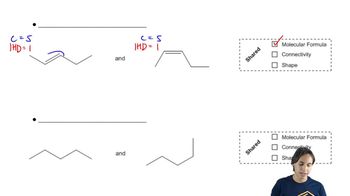
Stereoisomerism refers to the phenomenon where compounds have the same molecular formula and connectivity of atoms but differ in the spatial arrangement of those atoms. This can lead to different physical and chemical properties. In the case of alkenes, stereoisomers can arise from the restricted rotation around the double bond, resulting in cis and trans configurations.
Recommended video:
Guided course
01:58
Determining when molecules are stereoisomers.

Electrophilic Addition Reactions

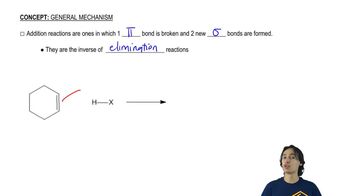
Electrophilic addition reactions are a fundamental type of reaction for alkenes, where an electrophile reacts with the double bond, leading to the formation of a more saturated compound. In the case of (S)-3-methyl-1-pentene reacting with Cl2, the chlorine molecules act as electrophiles, adding across the double bond and resulting in the formation of vicinal dihalides.
Recommended video:
Guided course
05:39
Features of Addition Mechanisms.

Chirality and Enantiomers

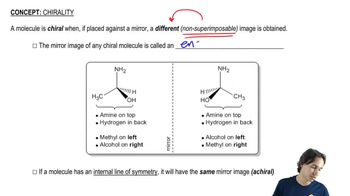
Chirality is a property of a molecule that makes it non-superimposable on its mirror image, often due to the presence of a chiral center, typically a carbon atom bonded to four different substituents. When (S)-3-methyl-1-pentene reacts with Cl2, the formation of chiral products can lead to the generation of enantiomers, which are pairs of molecules that are mirror images of each other, impacting the overall stereochemistry of the reaction.
Recommended video:
Guided course
05:10
What is chirality?