Ch. 7 - The Reactions of Alkynes • An Introduction to Multistep Synthesis
Bruice - Organic Chemistry 8th Edition
Bruice8th EditionOrganic ChemistryISBN: 9780135213711Not the one you use?Change textbook
Chapter 8, Problem 36

Draw the mechanism for the following reaction:

Verified step by step guidance
1
Step 1: Analyze the reactants and reagents. The starting material is 1-pentyne (CH₃CH₂CH₂C≡CH), and the reaction involves bromine (Br₂) in water (H₂O). This suggests a halohydration reaction mechanism, where bromine adds across the triple bond in the presence of water.
Step 2: Initiate the reaction mechanism. Bromine (Br₂) acts as an electrophile and is polarized due to the electron density of the triple bond. The π-electrons of the alkyne attack Br₂, forming a cyclic bromonium ion intermediate.
Step 3: Water (H₂O) acts as a nucleophile and attacks the more substituted carbon of the bromonium ion, leading to the opening of the cyclic intermediate. This results in the addition of a hydroxyl group (-OH) to the more substituted carbon and a bromine atom to the less substituted carbon.
Step 4: The hydroxyl group undergoes tautomerization. The enol intermediate (CH₃CH₂CH₂C(OH)=CHBr) rearranges to form a more stable keto form (CH₃CH₂CH₂C(O)CH₂Br). This keto-enol tautomerization is facilitated by the acidic or basic conditions in the reaction medium.
Step 5: Verify the final product. The reaction yields 2-bromo-2-pentanone (CH₃CH₂CH₂C(O)CH₂Br), where the bromine atom and the carbonyl group are attached to adjacent carbons. This is consistent with the halohydration mechanism and the given product structure.

Verified video answer for a similar problem:

This video solution was recommended by our tutors as helpful for the problem above.
Video duration:
8m
Was this helpful?

Key Concepts

Here are the essential concepts you must grasp in order to answer the question correctly.

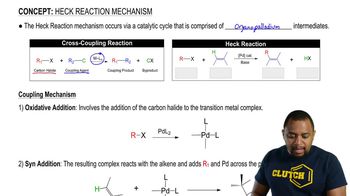
Reaction Mechanism

A reaction mechanism is a step-by-step description of how a chemical reaction occurs at the molecular level. It outlines the sequence of elementary steps, including bond breaking and formation, and the intermediates formed during the reaction. Understanding the mechanism is crucial for predicting the products and the conditions under which the reaction occurs.
Recommended video:
Guided course
02:16
Heck Reaction Mechanism

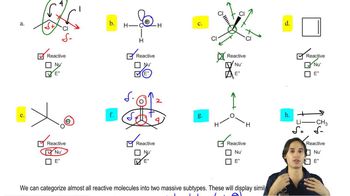
Nucleophiles and Electrophiles

Nucleophiles are species that donate an electron pair to form a chemical bond, while electrophiles are species that accept an electron pair. In organic reactions, identifying the nucleophile and electrophile is essential for understanding how the reaction proceeds. Their interaction often drives the formation of new bonds and the transformation of reactants into products.
Recommended video:
Guided course
03:
Nucleophile or Electrophile

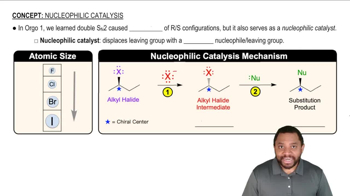
Catalysis

Catalysis refers to the process of increasing the rate of a chemical reaction by adding a substance known as a catalyst, which is not consumed in the reaction. Catalysts can provide an alternative pathway with a lower activation energy, making reactions more efficient. Understanding the role of catalysts is important for analyzing reaction mechanisms and optimizing reaction conditions.
Recommended video:
2:31
Nucleophilic Catalysis Concept 1