Ch. 7 - The Reactions of Alkynes • An Introduction to Multistep Synthesis
Bruice - Organic Chemistry 8th Edition
Bruice8th EditionOrganic ChemistryISBN: 9780135213711Not the one you use?Change textbook
Chapter 8, Problem 20b

What are products of the following reactions?
b. Reaction diagram showing an alkyne reacting with hydrogen and a Lindlar catalyst.

Verified step by step guidance
1
Identify the functional group in the reactant: The reactant contains a terminal alkyne group (a carbon-carbon triple bond).
Understand the role of Lindlar's catalyst: Lindlar's catalyst is a poisoned catalyst used for the selective hydrogenation of alkynes to alkenes. It stops the reaction at the alkene stage and does not reduce the alkene further to an alkane.
Determine the stereochemistry of the product: Lindlar's catalyst produces a cis-alkene (both substituents on the same side of the double bond) due to the syn addition of hydrogen.
Analyze the structure of the reactant: The triple bond in the reactant will be converted into a double bond, and the substituents attached to the carbons involved in the triple bond will remain unchanged.
Draw the product structure: Replace the triple bond in the reactant with a cis double bond, ensuring the substituents on the carbons involved in the bond are positioned on the same side.

Verified video answer for a similar problem:

This video solution was recommended by our tutors as helpful for the problem above.
Video duration:
2m
Was this helpful?

Key Concepts

Here are the essential concepts you must grasp in order to answer the question correctly.

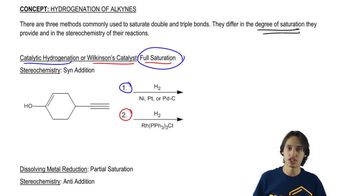
Hydrogenation of Alkynes

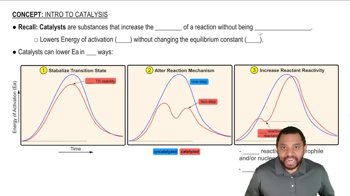
Hydrogenation is a chemical reaction that involves the addition of hydrogen (H2) to an unsaturated compound, such as an alkyne. In this process, the triple bond of the alkyne is converted into a double bond, resulting in the formation of an alkene. This reaction is typically facilitated by a catalyst, which lowers the activation energy required for the reaction to occur.
Recommended video:
Guided course
03:46
Using Catalytic hydrogenation or Wilkinson’s Catalyst to turn alkynes to alkanes.

Lindlar Catalyst

The Lindlar catalyst is a specific type of palladium catalyst that is used to selectively hydrogenate alkynes to cis-alkenes. It is a poisoned catalyst, meaning it has been modified to prevent complete hydrogenation to alkanes, allowing for the formation of alkenes while controlling the reaction conditions. This selectivity is crucial in organic synthesis when specific stereochemistry is desired.
Recommended video:
2:10
Introduction to Catalysis Concept 1

Stereochemistry of Alkenes

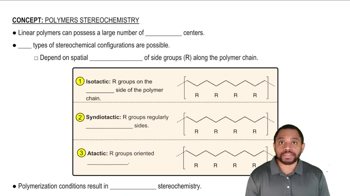
Stereochemistry refers to the spatial arrangement of atoms in molecules and how this affects their chemical behavior. In the case of alkenes produced from alkyne hydrogenation, the configuration can be either cis or trans. The Lindlar catalyst specifically produces cis-alkenes, which have substituents on the same side of the double bond, influencing their physical properties and reactivity in subsequent reactions.
Recommended video:
1:38
Polymer Stereochemistry Concept 1