Ch. 7 - The Reactions of Alkynes • An Introduction to Multistep Synthesis
Bruice - Organic Chemistry 8th Edition
Bruice8th EditionOrganic ChemistryISBN: 9780135213711Not the one you use?Change textbook
Chapter 8, Problem 34b,c

What reagents should be used to carry out the following syntheses?
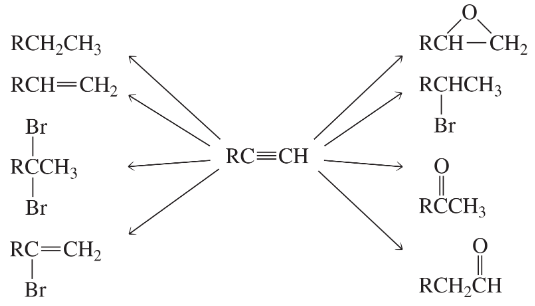
Diagram illustrating alkyne halogenation reactions with various reagents and product structures.

Verified step by step guidance
1
Step 1: Analyze the first transformation (I). The starting material is an alkene, and the product is an alkyne. To convert an alkene to an alkyne, you need to perform a halogenation followed by dehydrohalogenation. First, treat the alkene with a halogen, such as Br2 or Cl2, to form a vicinal dihalide.
Step 2: For the second part of the first transformation (I), perform a double dehydrohalogenation on the vicinal dihalide using a strong base, such as NaNH2 in liquid ammonia, to form the alkyne.
Step 3: Analyze the second transformation (II). The starting material is an alkyne, and the product is a geminal dichloride. To achieve this, use hydrochloric acid (HCl) in excess. This reaction involves electrophilic addition of HCl to the alkyne, forming the geminal dichloride.
Step 4: Ensure that the reaction conditions for each step are appropriate. For halogenation, use a non-polar solvent like CCl4. For dehydrohalogenation, use liquid ammonia as the solvent. For electrophilic addition, use HCl in excess.
Step 5: Verify the stereochemistry and regiochemistry of the products formed in each step to ensure the desired compounds are synthesized correctly.

Verified video answer for a similar problem:

This video solution was recommended by our tutors as helpful for the problem above.
Video duration:
5m
Was this helpful?

Key Concepts

Here are the essential concepts you must grasp in order to answer the question correctly.

Alkyne Halogenation

Alkyne halogenation is a reaction where alkynes react with halogens (like Cl2 or Br2) to form dihaloalkenes or tetrahaloalkanes. This process involves the addition of halogen atoms across the triple bond of the alkyne, resulting in the saturation of the carbon atoms. Understanding the mechanism of this reaction is crucial for predicting the products and determining the appropriate reagents.
Recommended video:
Guided course
02:15
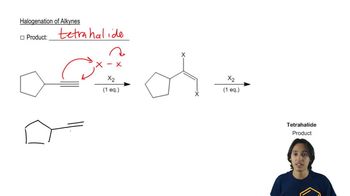
Double halogenation of alkynes.

Reagents for Halogenation

The choice of reagents in halogenation reactions is essential for achieving the desired product. Common reagents include diatomic halogens (e.g., Cl2, Br2) and sometimes Lewis acids to facilitate the reaction. The specific conditions, such as temperature and solvent, can also influence the reaction pathway and product distribution, making it important to select the right reagents for the synthesis.
Recommended video:
Guided course
03:45
Halogenation Mechanism

Stereochemistry in Halogenation

Stereochemistry plays a significant role in halogenation reactions, particularly in determining the configuration of the resulting products. The addition of halogens can lead to different stereoisomers, depending on the mechanism (anti or syn addition). Understanding how stereochemistry affects the outcome of the reaction is vital for predicting the structure of the final product and for designing synthesis pathways.
Recommended video:
1:38
Polymer Stereochemistry Concept 1