Ch. 7 - The Reactions of Alkynes • An Introduction to Multistep Synthesis
Bruice - Organic Chemistry 8th Edition
Bruice8th EditionOrganic ChemistryISBN: 9780135213711Not the one you use?Change textbook
Chapter 8, Problem 38b

What reagents would you use for the following syntheses?
b. (E)-3-hexene from 3-hexyne

Verified step by step guidance
1
Step 1: Begin by understanding the transformation required. The goal is to convert 3-hexyne (a triple bond) into (E)-3-hexene (a double bond with trans stereochemistry). This involves selective reduction of the alkyne to an alkene with control over stereochemistry.
Step 2: To achieve the (E)-configuration (trans alkene), use a dissolving metal reduction. This method typically involves reagents such as sodium (Na) in liquid ammonia (NH₃). The dissolving metal reduction selectively produces the trans alkene due to the mechanism of electron transfer and protonation.
Step 3: Write the reaction mechanism. The dissolving metal reduction involves the addition of electrons from sodium to the alkyne, forming a radical anion intermediate. Protonation from ammonia then leads to the trans alkene.
Step 4: Ensure stereochemical control. The dissolving metal reduction is preferred for forming the (E)-alkene because it minimizes steric hindrance and stabilizes the trans configuration during the reaction.
Step 5: Verify the product. After the reaction, confirm that the product is (E)-3-hexene by analyzing its stereochemistry using techniques such as NMR spectroscopy or IR spectroscopy to ensure the double bond is in the trans configuration.

Verified video answer for a similar problem:

This video solution was recommended by our tutors as helpful for the problem above.
Video duration:
3m
Was this helpful?

Key Concepts

Here are the essential concepts you must grasp in order to answer the question correctly.

Alkyne to Alkene Conversion

The conversion of alkynes to alkenes typically involves a process called hydrogenation or partial hydrogenation. In this case, 3-hexyne, a terminal alkyne, can be converted to (E)-3-hexene by using a reagent that selectively adds hydrogen across the triple bond, resulting in the formation of a double bond while maintaining the desired stereochemistry.
Recommended video:
Guided course
01:55
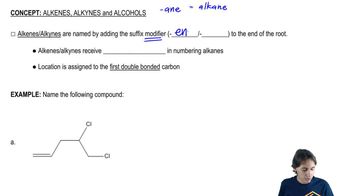
How to name alkenes and alkynes

Stereochemistry of Alkenes

Stereochemistry refers to the spatial arrangement of atoms in molecules and is crucial in determining the properties of alkenes. The (E) designation indicates that the higher priority substituents on either side of the double bond are on opposite sides, which can be achieved through careful selection of reagents during the synthesis process to ensure the correct geometric isomer is formed.
Recommended video:
1:38
Polymer Stereochemistry Concept 1

Reagents for Selective Hydrogenation

To achieve the selective hydrogenation of 3-hexyne to (E)-3-hexene, specific catalysts such as Lindlar's catalyst (palladium on calcium carbonate) can be used. This catalyst allows for the partial hydrogenation of alkynes to alkenes without fully saturating the double bond, thus preserving the desired alkene configuration.
Recommended video:
Guided course
05:21
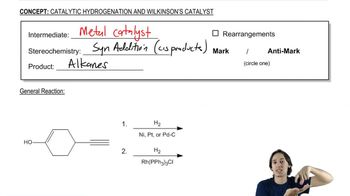
General properties of catalytic hydrogenation.