Ch. 7 - The Reactions of Alkynes • An Introduction to Multistep Synthesis
Bruice - Organic Chemistry 8th Edition
Bruice8th EditionOrganic ChemistryISBN: 9780135213711Not the one you use?Change textbook
Chapter 8, Problem 55a

What stereoisomers are obtained from the following reactions?
Chemical reaction showing the hydrogenation of an alkyne with reagents and conditions listed for stereoisomer formation.

Verified step by step guidance
1
Step 1: Analyze the starting material. The given compound is a terminal alkyne, (CH3)3CH2C≡CCH2(CH3)3. The triple bond is the reactive site in this molecule.
Step 2: Understand the first reaction conditions. Sodium (Na) in liquid ammonia (NH3) at −78°C is a classic setup for the Birch reduction. This reaction selectively reduces alkynes to trans-alkenes. The triple bond will be converted into a trans-alkene.
Step 3: Consider the stereochemistry of the trans-alkene. The two substituents on either side of the triple bond will end up on opposite sides of the double bond after the Birch reduction. This stereochemistry is important for determining the stereoisomers.
Step 4: Understand the second reaction conditions. D2 with Pd/C is a catalytic hydrogenation reaction, but instead of H2, deuterium gas (D2) is used. This reaction will reduce the double bond to a single bond, adding deuterium atoms to the molecule. Since the reduction is catalytic, the addition of deuterium is stereospecific and occurs in a syn fashion.
Step 5: Combine the results of both steps. After the Birch reduction, the molecule will have a trans-alkene configuration. The subsequent catalytic hydrogenation will add deuterium atoms to the molecule, resulting in a fully saturated alkane with specific stereochemistry based on the trans-alkene intermediate.

Verified video answer for a similar problem:

This video solution was recommended by our tutors as helpful for the problem above.
Video duration:
6m
Was this helpful?

Key Concepts

Here are the essential concepts you must grasp in order to answer the question correctly.

Stereoisomerism

Stereoisomerism refers to the phenomenon where compounds have the same molecular formula and connectivity of atoms but differ in the spatial arrangement of their atoms. This can lead to different physical and chemical properties. In organic chemistry, stereoisomers include enantiomers and diastereomers, which are crucial for understanding the behavior of molecules in reactions.
Recommended video:
Guided course
01:58
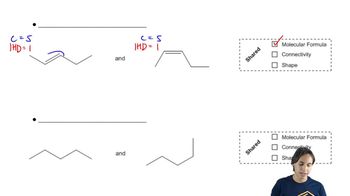
Determining when molecules are stereoisomers.

Alkyne Hydrogenation

Hydrogenation of alkynes involves the addition of hydrogen (H2) across the triple bond to form alkenes or alkanes. The reaction can be catalyzed by metals such as palladium (Pd) or nickel (Ni). The conditions of the reaction, such as temperature and the presence of solvents, can influence the stereochemistry of the resulting products, leading to the formation of different stereoisomers.
Recommended video:
Guided course
03:46
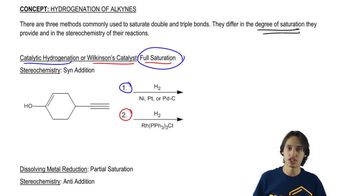
Using Catalytic hydrogenation or Wilkinson’s Catalyst to turn alkynes to alkanes.

Reduction with Sodium Ammonia

The reduction of alkynes using sodium in liquid ammonia (Na/NH3) leads to the formation of trans-alkenes. This reaction is characterized by the generation of a radical anion intermediate, which subsequently undergoes protonation. The stereochemistry of the product is important, as it determines the spatial arrangement of substituents around the double bond, influencing the types of stereoisomers formed.
Recommended video:
Guided course
07:12
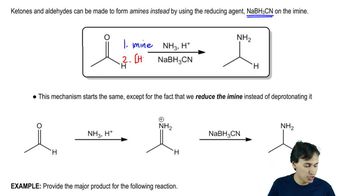
Reductive Amination