
Ch. 8 - Delocalized Electrons: Their Effect on Stability, pKa, and the Products of a Reaction • Aromaticity and Electronic Effects: An Introduction to the Reactions of Benzene
Bruice - Organic Chemistry 8th Edition
Bruice8th EditionOrganic ChemistryISBN: 9780135213711Not the one you use?Change textbook
Chapter 9, Problem 68(15)

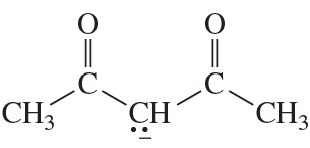
a. Draw resonance contributors for the following species. Do not include structures that are so unstable that their contributions to the resonance hybrid would be negligible. Indicate which are major contributors and which are minor contributors to the resonance hybrid.
b. Do any of the species have resonance contributors that all contribute equally to the resonance hybrid?
15. Two resonance structures of a molecule with carbon and oxygen atoms, showing double bonds and a negative charge.

Verified step by step guidance
1
Identify the species in question and determine if it has delocalized electrons, such as lone pairs, π bonds, or charges, which can participate in resonance.
Draw all possible resonance contributors by moving electrons (using curved arrows) while adhering to the rules of resonance: (1) Do not exceed the octet rule for second-row elements, (2) Maintain the same number of electrons, and (3) Only move π electrons or lone pairs, not σ bonds.
Evaluate the stability of each resonance structure based on factors such as: (1) Full octets on atoms, (2) Minimal formal charges, and (3) Negative charges on more electronegative atoms or positive charges on less electronegative atoms. Label the most stable structures as major contributors and less stable ones as minor contributors.
For part (b), analyze the resonance contributors to determine if they are all equivalent in terms of stability. If all contributors have the same formal charges, atom connectivity, and distribution of electrons, they contribute equally to the resonance hybrid.
Summarize your findings by indicating which species have major and minor contributors and whether any species have resonance contributors that contribute equally to the resonance hybrid.

Verified video answer for a similar problem:

This video solution was recommended by our tutors as helpful for the problem above.
Video duration:
7m
Was this helpful?

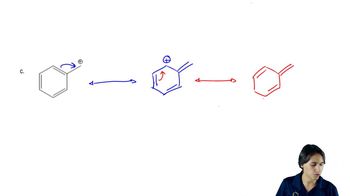
Key Concepts

Here are the essential concepts you must grasp in order to answer the question correctly.

Resonance Structures

Resonance structures are different Lewis structures for the same molecule that depict the delocalization of electrons. They are used to represent the actual electronic structure of a molecule more accurately, as the true structure is a hybrid of these contributors. Each resonance structure must obey the rules of valence and should not violate the octet rule for second-row elements.
Recommended video:
Guided course
03:04
Drawing Resonance Structures

Major and Minor Contributors

In resonance theory, major contributors are those resonance structures that are more stable and thus have a greater influence on the resonance hybrid. Factors such as the presence of formal charges, electronegativity, and the octet rule determine the stability of these structures. Minor contributors, while still valid, are less stable and contribute less to the overall hybrid structure.
Recommended video:
Guided course
04:42
Ortho, Para major products

Resonance Hybrid

The resonance hybrid is the actual structure of a molecule that is a weighted average of all its resonance contributors. It reflects the delocalization of electrons across the molecule, leading to increased stability. The resonance hybrid cannot be represented by any single resonance structure, and its properties are often intermediate between those of the individual contributors.
Recommended video:
Guided course
03:24
How to draw a resonance hybrid.
Related Practice
Textbook Question

a. Draw resonance contributors for the following species. Do not include structures that are so unstable that their contributions to the resonance hybrid would be negligible. Indicate which are major contributors and which are minor contributors to the resonance hybrid.

b. Do any of the species have resonance contributors that all contribute equally to the resonance hybrid?

3.

882
views
Textbook Question

a. Draw resonance contributors for the following species. Do not include structures that are so unstable that their contributions to the resonance hybrid would be negligible. Indicate which are major contributors and which are minor contributors to the resonance hybrid.

b. Do any of the species have resonance contributors that all contribute equally to the resonance hybrid?

10.


852
views
Textbook Question

Are the following pairs of structures resonance contributors or different compounds?

d.

e.

1447
views
Textbook Question

a. Draw resonance contributors for the following species. Do not include structures that are so unstable that their contributions to the resonance hybrid would be negligible. Indicate which are major contributors and which are minor contributors to the resonance hybrid.

b. Do any of the species have resonance contributors that all contribute equally to the resonance hybrid?

5.

1231
views
Textbook Question

a. How many linear dienes have molecular formula C6H10? (Disregard cis–trans isomers.)

b. How many of the linear dienes in part a are conjugated dienes?

1712
views
Textbook Question

Draw all the products of the following reaction:

745
views