Ch. 8 - Delocalized Electrons: Their Effect on Stability, pKa, and the Products of a Reaction • Aromaticity and Electronic Effects: An Introduction to the Reactions of Benzene
Bruice - Organic Chemistry 8th Edition
Bruice8th EditionOrganic ChemistryISBN: 9780135213711Not the one you use?Change textbook
Chapter 9, Problem 102b

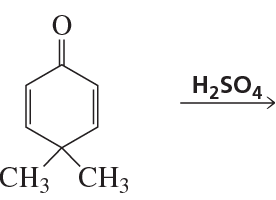
What is the product of the following reaction?
Chemical structure showing a dehydration reaction with a benzene ring, methyl groups, and sulfuric acid as a reagent.

Verified step by step guidance
1
Step 1: Analyze the structure of the reactant. The molecule contains a ketone group (C=O) and a conjugated diene system within a cyclohexane ring. The reaction involves concentrated sulfuric acid (H2SO4), which is a strong acid and dehydrating agent.
Step 2: Recognize the role of H2SO4 in the reaction. Sulfuric acid can protonate the ketone oxygen, making the carbonyl carbon more electrophilic. This can lead to further reactions such as rearrangements or eliminations.
Step 3: Consider the possibility of an intramolecular aldol condensation. The conjugated diene system and the ketone group suggest that the reaction may involve the formation of a new bond between the alpha-carbon of the ketone and one of the double bonds in the diene system.
Step 4: Predict the mechanism. The reaction likely proceeds through protonation of the ketone oxygen, followed by nucleophilic attack from the diene system. This could result in the formation of a new cyclic structure, potentially with aromatic stabilization.
Step 5: Verify the product structure. After the reaction mechanism is complete, the product is expected to be a more stable compound, possibly involving aromaticity or a rearranged cyclic structure. Ensure that the final product adheres to the principles of stability and resonance.

Verified video answer for a similar problem:

This video solution was recommended by our tutors as helpful for the problem above.
Video duration:
5m
Was this helpful?

Key Concepts

Here are the essential concepts you must grasp in order to answer the question correctly.

Dehydration Reaction

A dehydration reaction involves the removal of a water molecule from a compound, often resulting in the formation of a double bond. In organic chemistry, this process is commonly catalyzed by acids, such as sulfuric acid (H2SO4), which helps to protonate the alcohol or other functional groups, facilitating the elimination of water.
Recommended video:
Guided course
01:23
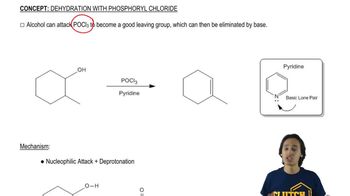
General Reaction of Dehydration with POCl3

Electrophilic Aromatic Substitution

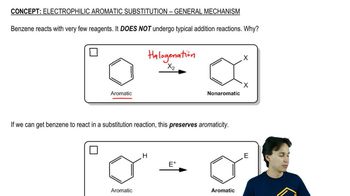
Electrophilic aromatic substitution is a fundamental reaction mechanism in organic chemistry where an electrophile replaces a hydrogen atom on an aromatic ring. This process is crucial for understanding how substituents can modify the reactivity and properties of aromatic compounds, often leading to the formation of more complex structures.
Recommended video:

Role of Catalysts

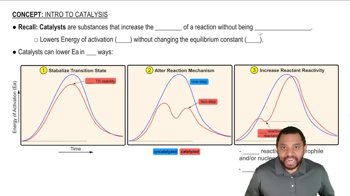
Catalysts are substances that increase the rate of a chemical reaction without being consumed in the process. In the context of the given reaction, H2SO4 acts as a catalyst, providing protons that facilitate the dehydration of the starting material, thereby enhancing the formation of the desired product while allowing the catalyst to remain unchanged.
Recommended video:
2:10
Introduction to Catalysis Concept 1