Ch. 8 - Delocalized Electrons: Their Effect on Stability, pKa, and the Products of a Reaction • Aromaticity and Electronic Effects: An Introduction to the Reactions of Benzene
Bruice - Organic Chemistry 8th Edition
Bruice8th EditionOrganic ChemistryISBN: 9780135213711Not the one you use?Change textbook
Chapter 9, Problem 64a

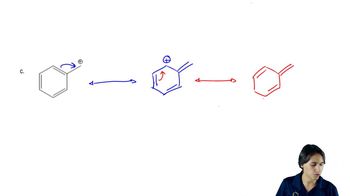
Draw resonance contributors for the following ions:
a.

Verified step by step guidance
1
Step 1: Identify the ion provided in the structure. The structure shows a carbocation (positively charged carbon atom) located at the end of the chain. This carbocation is adjacent to a conjugated system of alternating double and single bonds, which allows for resonance.
Step 2: Recognize the resonance concept. Resonance contributors are alternative Lewis structures that represent the delocalization of electrons in a molecule. In this case, the π-electrons from the double bonds can shift to stabilize the carbocation.
Step 3: Begin drawing the first resonance contributor. Move the π-electrons from the double bond closest to the carbocation toward the carbocation. This creates a new double bond between the carbocation and the adjacent carbon, while the original double bond shifts to the next carbon-carbon bond.
Step 4: Continue drawing additional resonance contributors. Repeat the process of shifting π-electrons along the conjugated system. Each time, the positive charge moves to the next carbon atom in the chain, and the double bonds adjust accordingly.
Step 5: Verify the resonance contributors. Ensure that all resonance structures follow the rules of valency and maintain the overall charge of the molecule. The resonance contributors should collectively represent the delocalization of the positive charge across the conjugated system.

Verified video answer for a similar problem:

This video solution was recommended by our tutors as helpful for the problem above.
Video duration:
7m
Was this helpful?

Key Concepts

Here are the essential concepts you must grasp in order to answer the question correctly.

Resonance Structures

Resonance structures are different Lewis structures for the same molecule that depict the same arrangement of atoms but differ in the distribution of electrons. These structures help illustrate the delocalization of electrons within a molecule, which can stabilize the ion or molecule. Understanding resonance is crucial for predicting the reactivity and stability of organic compounds.
Recommended video:
Guided course
03:04
Drawing Resonance Structures

Delocalization of Electrons

Delocalization of electrons refers to the phenomenon where electrons are spread over several atoms rather than being localized between two atoms. This occurs in systems with conjugated double bonds or lone pairs adjacent to double bonds, leading to increased stability. Recognizing delocalization is essential for drawing accurate resonance contributors and understanding the overall electronic structure of the ion.
Recommended video:
Guided course
03:54
The 18 and 16 Electron Rule

Formal Charge

Formal charge is a theoretical charge assigned to an atom in a molecule, calculated based on the number of valence electrons, the number of bonds, and the number of non-bonding electrons. It helps in determining the most stable resonance structure, as the best contributors typically have formal charges closest to zero. Understanding formal charge is vital for evaluating the stability and reactivity of resonance structures.
Recommended video:
Guided course
01:34
Calculating formal and net charge.