Ch. 8 - Delocalized Electrons: Their Effect on Stability, pKa, and the Products of a Reaction • Aromaticity and Electronic Effects: An Introduction to the Reactions of Benzene
Bruice - Organic Chemistry 8th Edition
Bruice8th EditionOrganic ChemistryISBN: 9780135213711Not the one you use?Change textbook
Chapter 9, Problem 46b

Explain why the following compounds are not optically active:
b. the product obtained from the reaction of 1,3-butadiene with trans-1,2-dichloroethene

Verified step by step guidance
1
Identify the type of reaction occurring between 1,3-butadiene and trans-1,2-dichloroethene. This is a Diels-Alder reaction, which is a [4+2] cycloaddition reaction where the diene (1,3-butadiene) reacts with a dienophile (trans-1,2-dichloroethene) to form a cyclohexene derivative.
Analyze the symmetry of the reactants. Trans-1,2-dichloroethene is symmetric due to the trans arrangement of the chlorine atoms across the double bond. This symmetry will influence the stereochemistry of the product.
Examine the stereochemistry of the product. The Diels-Alder reaction is stereospecific, meaning the stereochemistry of the dienophile is preserved in the product. Since trans-1,2-dichloroethene is symmetric, the product will also have a plane of symmetry.
Determine the optical activity of the product. For a compound to be optically active, it must lack a plane of symmetry and have a chiral center. In this case, the product has a plane of symmetry, making it achiral and therefore not optically active.
Conclude that the product obtained from the reaction of 1,3-butadiene with trans-1,2-dichloroethene is not optically active because it is achiral due to the presence of a plane of symmetry in the molecule.

Verified video answer for a similar problem:

This video solution was recommended by our tutors as helpful for the problem above.
Video duration:
6m
Was this helpful?

Key Concepts

Here are the essential concepts you must grasp in order to answer the question correctly.

Optical Activity

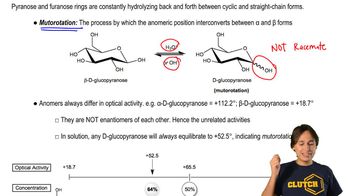
Optical activity refers to the ability of a compound to rotate the plane of polarized light. This property is typically exhibited by chiral molecules, which lack an internal plane of symmetry and have non-superimposable mirror images. Compounds that are achiral, or have a plane of symmetry, do not exhibit optical activity.
Recommended video:
Guided course
08:17
Mutorotation and Optical Activity

Chirality

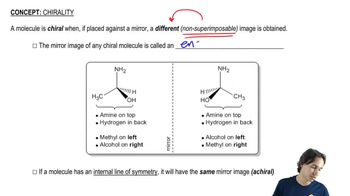
Chirality is a geometric property of some molecules that makes them non-superimposable on their mirror images. A chiral molecule usually has at least one carbon atom bonded to four different substituents, creating two enantiomers. In contrast, if a molecule has symmetry or identical substituents, it is achiral and cannot rotate polarized light.
Recommended video:
Guided course
05:10
What is chirality?

Reaction Mechanism of 1,3-Butadiene and Trans-1,2-Dichloroethene

The reaction between 1,3-butadiene and trans-1,2-dichloroethene involves a Diels-Alder cycloaddition mechanism, which can lead to the formation of a cyclic compound. The symmetry of the reactants and the resulting product can lead to the formation of a compound that possesses a plane of symmetry, thus rendering it achiral and optically inactive.
Recommended video:
Guided course
02:16
Heck Reaction Mechanism