
Ch. 8 - Delocalized Electrons: Their Effect on Stability, pKa, and the Products of a Reaction • Aromaticity and Electronic Effects: An Introduction to the Reactions of Benzene
Bruice - Organic Chemistry 8th Edition
Bruice8th EditionOrganic ChemistryISBN: 9780135213711Not the one you use?Change textbook
Chapter 9, Problem 8a

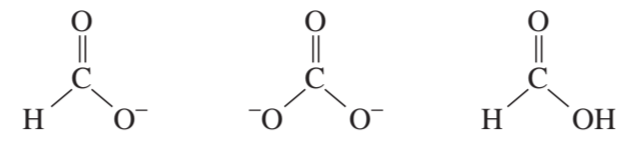
List the following in order of decreasing delocalization energy:
Three molecular structures showing conjugated intermediates with varying delocalization energy, labeled with atoms and bonds.

Verified step by step guidance
1
Identify the molecules or structures provided in the problem. Delocalization energy is related to the stability provided by resonance, so focus on structures with conjugated π-systems or resonance contributors.
Determine the extent of conjugation in each structure. Molecules with more extensive conjugation (e.g., alternating single and double bonds in a cyclic or linear system) generally have higher delocalization energy.
Analyze the resonance contributors for each structure. Count the number of valid resonance forms and assess their relative stability. Structures with more significant resonance stabilization will have higher delocalization energy.
Consider any additional factors that influence delocalization energy, such as aromaticity. Aromatic compounds (following Hückel's rule: 4n+2 π-electrons) have exceptionally high delocalization energy compared to non-aromatic or anti-aromatic compounds.
Rank the structures in order of decreasing delocalization energy based on the above analysis, starting with the structure that has the most extensive conjugation, resonance stabilization, or aromaticity.

Verified video answer for a similar problem:

This video solution was recommended by our tutors as helpful for the problem above.
Was this helpful?

Key Concepts

Here are the essential concepts you must grasp in order to answer the question correctly.

Delocalization Energy

Delocalization energy refers to the stabilization that occurs when electrons are spread out over multiple atoms rather than localized between two. This phenomenon is commonly observed in conjugated systems and aromatic compounds, where resonance structures contribute to the overall stability of the molecule. The greater the extent of delocalization, the higher the delocalization energy, which influences the reactivity and properties of organic compounds.
Recommended video:
Guided course
06:07
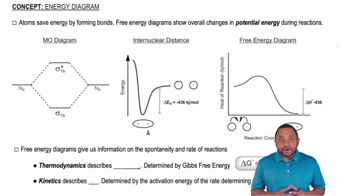
Introduction to free energy diagrams.

Resonance Structures

Resonance structures are different Lewis structures that represent the same molecule, illustrating how electrons can be distributed across multiple bonds. These structures help visualize the delocalization of electrons, which contributes to the overall stability of the molecule. The actual structure of the molecule is a hybrid of these resonance forms, and the more significant the contribution of a resonance structure, the more stable the molecule is due to delocalization.
Recommended video:
Guided course
03:04
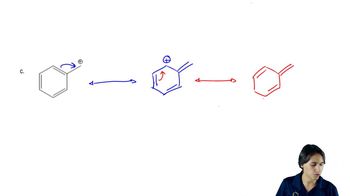
Drawing Resonance Structures

Aromaticity

Aromaticity is a property of cyclic compounds that exhibit enhanced stability due to delocalized pi electrons following Hückel's rule (4n + 2 pi electrons). Aromatic compounds, such as benzene, have a planar structure and a continuous overlap of p-orbitals, allowing for significant electron delocalization. This delocalization leads to lower energy and increased stability, making aromatic compounds less reactive than their non-aromatic counterparts.
Recommended video:
Guided course
08:19
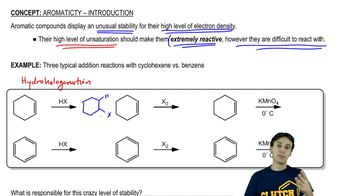
Intro to Aromaticity