Ch. 8 - Delocalized Electrons: Their Effect on Stability, pKa, and the Products of a Reaction • Aromaticity and Electronic Effects: An Introduction to the Reactions of Benzene
Bruice - Organic Chemistry 8th Edition
Bruice8th EditionOrganic ChemistryISBN: 9780135213711Not the one you use?Change textbook
Chapter 9, Problem 28c

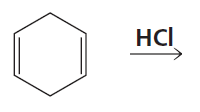
What are the products of the following reactions, assuming that one equivalent of each reagent is used in each reaction?
c. Benzene ring with HCl reagent indicating a reaction for conjugated hydrohalogenation.

Verified step by step guidance
1
Analyze the structure of the starting material: The molecule is a substituted benzene ring with an isopropyl group attached to the aromatic ring. This is known as isopropylbenzene or cumene.
Identify the reagent: Chlorine (Cl₂) is used in the reaction, and the absence of light or heat suggests that this is an electrophilic aromatic substitution reaction rather than a free radical halogenation.
Understand the mechanism: In electrophilic aromatic substitution, the chlorine molecule reacts with the aromatic ring, and one hydrogen atom is replaced by a chlorine atom. The isopropyl group is an electron-donating group, which activates the aromatic ring and directs substitution to the ortho and para positions relative to the isopropyl group.
Predict the products: Since one equivalent of chlorine is used, the reaction will yield a mixture of ortho-chlorocumene and para-chlorocumene as the major products. The meta position is less favored due to the electron-donating effect of the isopropyl group.
Consider regioselectivity: The para product is typically favored over the ortho product due to steric hindrance at the ortho position caused by the bulky isopropyl group.

Verified video answer for a similar problem:

This video solution was recommended by our tutors as helpful for the problem above.
Video duration:
4m
Was this helpful?

Key Concepts

Here are the essential concepts you must grasp in order to answer the question correctly.

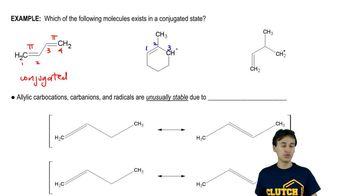
Conjugated Systems

Conjugated systems consist of alternating single and double bonds, allowing for delocalization of π electrons. This delocalization stabilizes the molecule and can influence its reactivity. In the context of the reaction shown, the conjugated diene can undergo electrophilic addition, where reagents like Cl2 can add across the double bonds.
Recommended video:
Guided course
03:27
Conjugated states

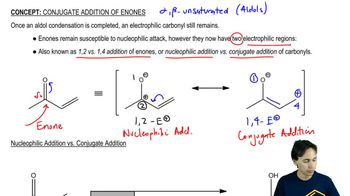
Electrophilic Addition

Electrophilic addition is a reaction mechanism where an electrophile reacts with a nucleophile, resulting in the addition of atoms or groups to a molecule. In this case, Cl2 acts as an electrophile that adds to the double bonds of the conjugated system, leading to the formation of vicinal dihalides. Understanding this mechanism is crucial for predicting the products of the reaction.
Recommended video:
Guided course
09:23
1,2 vs 1,4 Addition

Regioselectivity

Regioselectivity refers to the preference of a chemical reaction to yield one structural isomer over others when multiple possibilities exist. In the reaction with Cl2, the regioselectivity will determine which carbon atoms in the conjugated system will bond with chlorine, influencing the final product's structure. This concept is essential for accurately predicting the outcome of the reaction.
Recommended video:
Guided course
05:09
Heck Reaction