Ch. 9 - Substitution and Elimination Reactions of Alkyl Halides
Bruice - Organic Chemistry 8th Edition
Bruice8th EditionOrganic ChemistryISBN: 9780135213711Not the one you use?Change textbook
Chapter 10, Problem 65a,b

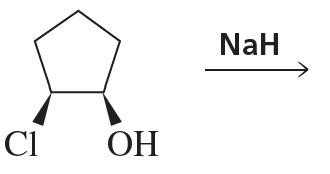
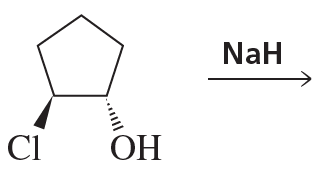
Draw the products of the following intramolecular reactions:
a. Chemical structure showing a cyclohexane with Cl and OH groups, and NaH as a reagent for intramolecular reactions.
b. Chemical structure showing a cyclic compound with Cl and OH groups, reacting with NaH to illustrate elimination reactions.

Verified step by step guidance
1
Step 1: Analyze the given structures for both reactions. In reaction (a), the molecule contains a hydroxyl group (-OH) and a bromine atom (-Br) on adjacent carbons. In reaction (b), the molecule also contains a hydroxyl group (-OH) and a bromine atom (-Br), but they are on opposite sides of the cyclohexane ring.
Step 2: For reaction (a), the first reagent, NaH (sodium hydride), acts as a strong base. It will deprotonate the hydroxyl group (-OH), forming an alkoxide ion (-O⁻). This alkoxide ion is highly nucleophilic and can attack the adjacent carbon bonded to the bromine atom, leading to an intramolecular substitution reaction (S_N2 mechanism).
Step 3: In reaction (a), the bromine atom (-Br) acts as a leaving group during the S_N2 reaction. The nucleophilic attack by the alkoxide ion results in the formation of an epoxide (a three-membered cyclic ether). The stereochemistry of the product will depend on the stereochemistry of the starting material.
Step 4: For reaction (b), NaH will again deprotonate the hydroxyl group (-OH), forming an alkoxide ion (-O⁻). However, due to the anti-periplanar geometry required for an S_N2 reaction, the bromine atom (-Br) is positioned ideally for the alkoxide ion to attack the carbon bonded to bromine, leading to the formation of an epoxide.
Step 5: In both reactions, the final product is an epoxide. The stereochemistry of the epoxide will depend on the stereochemistry of the starting material and the intramolecular attack. Ensure to carefully draw the epoxide products with the correct stereochemistry based on the original configurations of the substituents.

Verified video answer for a similar problem:

This video solution was recommended by our tutors as helpful for the problem above.
Video duration:
6m
Was this helpful?

Key Concepts

Here are the essential concepts you must grasp in order to answer the question correctly.

Intramolecular Reactions

Intramolecular reactions occur within a single molecule, leading to the formation of new bonds and the rearrangement of functional groups. These reactions often involve the formation of cyclic structures or the elimination of small molecules, such as water or hydrogen halides. Understanding the mechanism of these reactions is crucial for predicting the products formed.
Recommended video:
2:29
Rates of Intramolecular Reactions Concept 1

Elimination Reactions

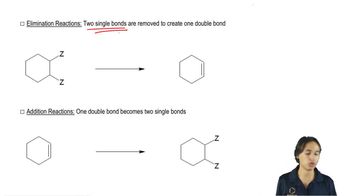
Elimination reactions involve the removal of atoms or groups from a molecule, resulting in the formation of a double bond or a ring structure. In the context of the provided question, the elimination of bromine and hydroxyl groups leads to the formation of alkenes or cyclic compounds. Recognizing the conditions and reagents that facilitate these reactions is essential for determining the products.
Recommended video:
Guided course
00:40
Recognizing Elimination Reactions.

Reagents and Reaction Conditions

The choice of reagents and reaction conditions significantly influences the outcome of organic reactions. In the given question, sodium hydride (NaH) acts as a strong base to deprotonate the alcohol, facilitating the elimination process. Understanding how different reagents interact with substrates helps predict the products and mechanisms of the reactions.
Recommended video: