Ch. 9 - Substitution and Elimination Reactions of Alkyl Halides
Bruice - Organic Chemistry 8th Edition
Bruice8th EditionOrganic ChemistryISBN: 9780135213711Not the one you use?Change textbook
Chapter 10, Problem 96d

For each of the following alkyl halides, indicate the stereoisomer that would be obtained in greatest yield in an E2 reaction.
d. 3-bromo-3,4-dimethylhexane

Verified step by step guidance
1
Identify the substrate: The given compound is 3-bromo-3,4-dimethylhexane, which is a tertiary alkyl halide. Tertiary alkyl halides are highly favorable for E2 elimination reactions due to steric hindrance that disfavors substitution reactions.
Recall the E2 mechanism: E2 elimination is a one-step concerted reaction where a base abstracts a β-hydrogen (hydrogen on a carbon adjacent to the carbon bearing the leaving group), and the leaving group (in this case, bromine) departs simultaneously, forming a double bond.
Determine the β-hydrogens: In 3-bromo-3,4-dimethylhexane, the β-carbons are the carbons adjacent to the carbon bonded to the bromine (C-3). These are C-2 and C-4. Examine the hydrogens on these β-carbons to identify possible elimination sites.
Apply anti-periplanar geometry: For the E2 reaction to proceed, the β-hydrogen and the leaving group (bromine) must be in an anti-periplanar (coplanar but opposite) arrangement. Analyze the Newman projection or the 3D structure of the molecule to determine which β-hydrogen satisfies this geometric requirement.
Predict the major product: The major product of the E2 reaction will be the most stable alkene, which is typically the more substituted alkene (Zaitsev's rule). Compare the possible alkenes formed by elimination at C-2 and C-4, and identify the stereoisomer with the greatest yield based on stability and anti-periplanar geometry.

Verified video answer for a similar problem:

This video solution was recommended by our tutors as helpful for the problem above.
Video duration:
3m
Was this helpful?

Key Concepts

Here are the essential concepts you must grasp in order to answer the question correctly.

E2 Reaction Mechanism

The E2 (bimolecular elimination) reaction is a concerted process where a base abstracts a proton while a leaving group departs, resulting in the formation of a double bond. This mechanism typically requires a strong base and is stereospecific, favoring the formation of the more stable alkene. Understanding the stereochemistry involved is crucial for predicting the major product.
Recommended video:
Guided course
09:36
Drawing the E2 Mechanism.

Stereochemistry and Alkene Stability

Stereochemistry refers to the spatial arrangement of atoms in molecules, which significantly influences the stability of alkenes. In E2 reactions, the formation of trans alkenes is generally favored over cis due to reduced steric strain. Recognizing the stereochemical outcomes helps in determining which isomer will be produced in greater yield.
Recommended video:
Guided course
04:28
Understanding trends of alkene stability.

Substituent Effects on Elimination Reactions

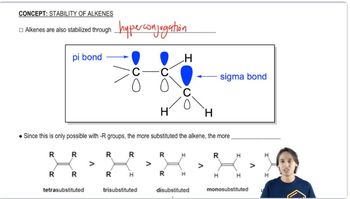
The presence and position of substituents on the alkyl halide can greatly affect the outcome of E2 reactions. Bulky groups near the leaving group can hinder the approach of the base, while more substituted alkenes are typically more stable due to hyperconjugation and inductive effects. Analyzing the structure of 3-bromo-3,4-dimethylhexane is essential to predict the major product.
Recommended video:
Guided course
00:38
Intro to Substitution/Elimination Problems