Ch. 9 - Substitution and Elimination Reactions of Alkyl Halides
Bruice - Organic Chemistry 8th Edition
Bruice8th EditionOrganic ChemistryISBN: 9780135213711Not the one you use?Change textbook
Chapter 10, Problem 55b

How will the rate of each of the following SN2 reactions change if it is carried out in a more polar solvent?
b.

Verified step by step guidance
1
Step 1: Understand the SN2 reaction mechanism. SN2 reactions are bimolecular nucleophilic substitution reactions where the nucleophile attacks the electrophilic carbon in a single, concerted step, leading to the displacement of the leaving group.
Step 2: Analyze the reaction provided. In this case, the nucleophile (NH3) attacks the electrophilic carbon attached to the leaving group (CH3SCH3+), resulting in the formation of CH3NH3+ and CH3SCH3.
Step 3: Consider the role of the solvent in SN2 reactions. Polar solvents can stabilize the charged transition state and intermediates. However, highly polar solvents may also stabilize the nucleophile, reducing its reactivity and slowing down the reaction rate.
Step 4: Evaluate the specific case. Since NH3 is a neutral nucleophile, a more polar solvent may stabilize the positively charged transition state (CH3SCH3+), potentially increasing the reaction rate. However, excessive stabilization of the nucleophile could counteract this effect.
Step 5: Conclude the impact of a more polar solvent. The rate of the SN2 reaction may increase slightly due to stabilization of the transition state, but the exact effect depends on the balance between nucleophile stabilization and transition state stabilization.

Verified video answer for a similar problem:

This video solution was recommended by our tutors as helpful for the problem above.
Video duration:
5m
Was this helpful?

Key Concepts

Here are the essential concepts you must grasp in order to answer the question correctly.

SN2 Mechanism

The SN2 (substitution nucleophilic bimolecular) mechanism involves a single concerted step where a nucleophile attacks an electrophile, leading to the simultaneous displacement of a leaving group. This reaction is characterized by a second-order kinetics, meaning the rate depends on the concentration of both the nucleophile and the substrate. Understanding this mechanism is crucial for predicting how changes in conditions, such as solvent polarity, will affect the reaction rate.
Recommended video:
Guided course
08:33
Drawing the SN2 Mechanism

Polar Solvents

Polar solvents are solvents that have a significant dipole moment, allowing them to stabilize charged species and polar interactions. In the context of SN2 reactions, polar solvents can stabilize the transition state and the nucleophile, which can enhance the reaction rate. The choice of solvent is critical, as it can influence the solubility of reactants and the overall kinetics of the reaction.
Recommended video:
Guided course
01:16
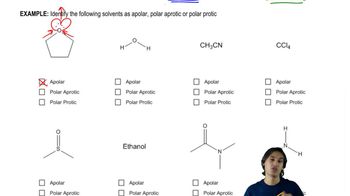
Identification of polarity in solvents

Nucleophilicity

Nucleophilicity refers to the ability of a nucleophile to donate an electron pair to an electrophile during a chemical reaction. In SN2 reactions, stronger nucleophiles typically lead to faster reaction rates. The polarity of the solvent can affect nucleophilicity; in polar protic solvents, nucleophiles may be less reactive due to solvation effects, while in polar aprotic solvents, nucleophiles remain more reactive, thus influencing the overall rate of the reaction.
Recommended video:
Guided course
08:27
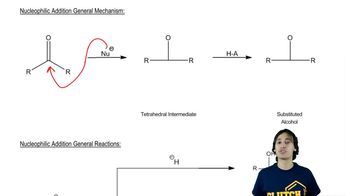
Nucleophilic Addition