


Ch. 9 - Substitution and Elimination Reactions of Alkyl Halides
Bruice - Organic Chemistry 8th Edition
Bruice8th EditionOrganic ChemistryISBN: 9780135213711Not the one you use?Change textbook
Chapter 10, Problem 3b

How will the rate of the reaction between bromomethane and hydroxide ion be affected if the following changes in concentration are made?
b. The concentration of the alkyl halide is cut in half and the concentration of the nucleophile is not changed.

Verified step by step guidance
1
Step 1: Identify the type of reaction mechanism involved. Bromomethane reacts with hydroxide ion via an SN2 mechanism, which is a bimolecular nucleophilic substitution reaction. The rate law for an SN2 reaction is given by: Rate=k[AlkylHalide][Nucleophile].
Step 2: Understand the relationship between the concentrations of reactants and the reaction rate. In an SN2 reaction, the rate is directly proportional to the concentration of both the alkyl halide and the nucleophile.
Step 3: Analyze the change in concentration of the alkyl halide. If the concentration of the alkyl halide is cut in half, the term [AlkylHalide] in the rate law will be halved.
Step 4: Consider the concentration of the nucleophile. Since the concentration of the nucleophile remains unchanged, the term [Nucleophile] in the rate law does not change.
Step 5: Combine the effects of the changes. The overall rate of the reaction will be halved because the rate is directly proportional to the concentration of the alkyl halide, and its concentration is reduced by half.

Verified video answer for a similar problem:

This video solution was recommended by our tutors as helpful for the problem above.
Video duration:
2m
Was this helpful?

Key Concepts

Here are the essential concepts you must grasp in order to answer the question correctly.

Nucleophilic Substitution Reactions

Nucleophilic substitution reactions involve the replacement of a leaving group in a molecule by a nucleophile. In this context, bromomethane (an alkyl halide) reacts with hydroxide ion (a nucleophile) to form an alcohol. The rate of these reactions can depend on the concentrations of the reactants and the mechanism (SN1 or SN2) involved.
Recommended video:
Guided course
01:47
Nucleophiles and Electrophiles can react in Substitution Reactions.

Rate Law

The rate law expresses the relationship between the rate of a chemical reaction and the concentration of its reactants. For a reaction involving bromomethane and hydroxide ion, the rate law can be determined by the order of the reaction with respect to each reactant. If the concentration of bromomethane is halved while the hydroxide concentration remains constant, the overall rate will be affected based on the reaction's order.
Recommended video:
5:07
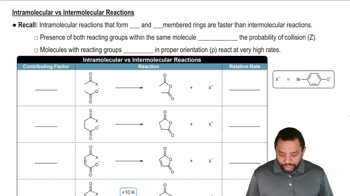
Rates of Intramolecular Reactions Concept 2

Reaction Mechanism

The reaction mechanism describes the step-by-step process by which reactants are converted into products. In nucleophilic substitution, the mechanism can be either SN1, which involves a two-step process with a carbocation intermediate, or SN2, which is a one-step process involving a direct attack by the nucleophile. Understanding the mechanism helps predict how changes in reactant concentrations will influence the reaction rate.
Recommended video:
Guided course
02:16
Heck Reaction Mechanism