
The reaction of an alkyl chloride with potassium iodide is generally carried out in acetone to maximize the amount of alkyl iodide that is formed. Why does the solvent increase the yield of alkyl iodide? (Hint: Potassium iodide is soluble in acetone, but potassium chloride is not.)
Ch. 9 - Substitution and Elimination Reactions of Alkyl Halides
All textbooks
Bruice 8th Edition
Ch. 9 - Substitution and Elimination Reactions of Alkyl Halides
Problem 124a
Bruice 8th Edition
Ch. 9 - Substitution and Elimination Reactions of Alkyl Halides
Problem 124aChapter 10, Problem 124a
Propose a mechanism for the following reaction.

Verified step by step guidance1
Step 1: Analyze the reactants and products. The starting material is a dibrominated ether, and the reaction involves methanol (CH₃OH) as a nucleophile. The products show substitution of one bromine atom with a methoxy group (-OCH₃) in two different positions, indicating a nucleophilic substitution reaction.
Step 2: Identify the mechanism type. This reaction likely proceeds via an SN2 mechanism because the bromine atoms are attached to a secondary carbon, which is sterically accessible for nucleophilic attack. Methanol acts as the nucleophile, attacking the carbon bonded to bromine.
Step 3: Describe the first substitution step. Methanol donates its lone pair of electrons to the carbon bonded to bromine, forming a transition state. Simultaneously, the bromine atom leaves as a bromide ion (Br⁻), resulting in the formation of the first product with a methoxy group replacing one bromine atom.
Step 4: Explain the second substitution step. The same process occurs at the other bromine-substituted carbon. Methanol attacks the carbon, displacing the bromine atom and forming the second product with a methoxy group replacing the bromine atom at the other position.
Step 5: Consider stereochemistry. Since the reaction involves an SN2 mechanism, the nucleophilic attack results in inversion of configuration at the carbon centers where substitution occurs. This explains the stereochemical differences observed in the products.

Verified video answer for a similar problem:
This video solution was recommended by our tutors as helpful for the problem above.
Video duration:
5mWas this helpful?
Key Concepts
Here are the essential concepts you must grasp in order to answer the question correctly.
Reaction Mechanism
A reaction mechanism is a step-by-step description of how a chemical reaction occurs at the molecular level. It outlines the sequence of elementary steps, including bond breaking and formation, and the intermediates formed during the reaction. Understanding the mechanism helps predict the products and the conditions under which the reaction occurs.
Recommended video:
Guided course
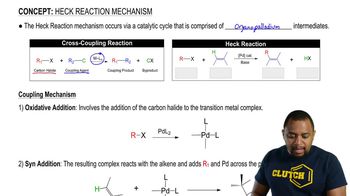
Heck Reaction Mechanism
Nucleophiles and Electrophiles
Nucleophiles are species that donate an electron pair to form a chemical bond, while electrophiles are electron-deficient species that accept an electron pair. Identifying these species in a reaction is crucial for proposing a mechanism, as it determines the direction of electron flow and the nature of the reaction pathway.
Recommended video:
Guided course
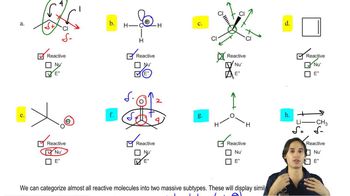
Nucleophile or Electrophile
Transition States and Intermediates
Transition states are high-energy states that occur during the transformation from reactants to products, representing the point of maximum energy along the reaction pathway. Intermediates are species that are formed and consumed during the reaction but are not present in the final products. Understanding these concepts is essential for accurately depicting the mechanism and energy changes involved.
Recommended video:
Guided course
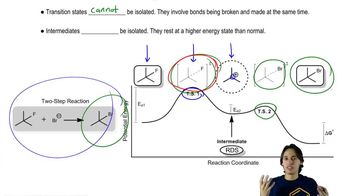
Intermediates vs. Transition States
Related Practice
Textbook Question
1022
views
Textbook Question
For each of the following compounds, draw the product that forms in an E2 reaction and indicate its configuration:
a. (1S,2S)-1-bromo-1,2-diphenylpropane
718
views
Textbook Question
What products are formed when the following stereoisomer of 2-chloro-1,3-dimethylcyclohexane reacts with methoxide ion?
1376
views
Textbook Question
Predict the product for the following reaction and write a mechanism to explain how it is formed.
2172
views
Textbook Question
Propose a mechanism for the following reaction:
1145
views
Textbook Question
Explain why tetrahydrofuran can solvate a positively charged species better than diethyl ether can.
1797
views