

When the following reactions are carried out under the same conditions, the rate constant for the first reaction (kH) is found to be 7 times greater than the rate constant for the second reaction (kD). What does that tell you about the mechanism of the reaction? (Hint: a C—D bond is 1.2 kcal/mol stronger than a C—H bond.)
Ch. 9 - Substitution and Elimination Reactions of Alkyl Halides
All textbooks
Bruice 8th Edition
Ch. 9 - Substitution and Elimination Reactions of Alkyl Halides
Problem 92c
Bruice 8th Edition
Ch. 9 - Substitution and Elimination Reactions of Alkyl Halides
Problem 92cChapter 10, Problem 92c
Starting with an alkyl halide, how could the following compounds be prepared?
c. butylmethylamine
Verified step by step guidance1
Step 1: Begin with an alkyl halide that corresponds to the desired alkyl group in the final product. For butylmethylamine, select 1-bromobutane or 1-chlorobutane as the starting alkyl halide.
Step 2: Perform a nucleophilic substitution reaction using methylamine (CH₃NH₂) as the nucleophile. Methylamine will attack the carbon bonded to the halogen in the alkyl halide, replacing the halogen atom.
Step 3: Ensure the reaction conditions are suitable for an SN2 mechanism. Use a polar aprotic solvent, such as acetone or DMSO, to facilitate the nucleophilic substitution reaction.
Step 4: Monitor the reaction to ensure the formation of butylmethylamine. The product will have the structure CH₃NHCH₂CH₂CH₂CH₃, where the butyl group is attached to the nitrogen atom.
Step 5: Purify the product using techniques such as distillation or extraction to isolate butylmethylamine from any unreacted starting materials or by-products.

Verified video answer for a similar problem:
This video solution was recommended by our tutors as helpful for the problem above.
Video duration:
5mWas this helpful?
Key Concepts
Here are the essential concepts you must grasp in order to answer the question correctly.
Alkyl Halides
Alkyl halides are organic compounds containing a carbon atom bonded to a halogen atom (such as chlorine, bromine, or iodine). They serve as versatile intermediates in organic synthesis, allowing for the introduction of various functional groups through nucleophilic substitution or elimination reactions. Understanding their reactivity is crucial for manipulating them to form desired products, such as amines.
Recommended video:
Guided course
How to name alkyl halides
Nucleophilic Substitution Reactions
Nucleophilic substitution reactions involve the replacement of a leaving group (like a halogen) in an alkyl halide with a nucleophile, which is a species that donates an electron pair. This process can occur via two main mechanisms: SN1 (unimolecular) and SN2 (bimolecular), each with distinct kinetics and stereochemical outcomes. Recognizing the appropriate mechanism is essential for synthesizing compounds like butylmethylamine from alkyl halides.
Recommended video:
Guided course
Nucleophiles and Electrophiles can react in Substitution Reactions.
Amines and Their Synthesis
Amines are organic compounds derived from ammonia by replacing one or more hydrogen atoms with alkyl or aryl groups. They can be synthesized from alkyl halides through nucleophilic substitution with ammonia or amines. Understanding the structure and reactivity of amines is vital for designing synthetic pathways to prepare compounds like butylmethylamine, which involves the introduction of both butyl and methyl groups.
Recommended video:
Guided course
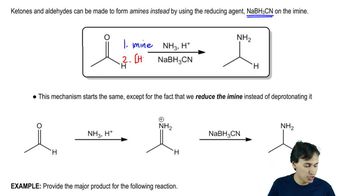
Reductive Amination
Related Practice
Textbook Question
1333
views
Textbook Question
Starting with an alkyl halide, how could the following compounds be prepared?
b. 1-methoxybutane
1125
views
1
rank
Textbook Question
Indicate which species in each pair gives a higher substitution-product-to-elimination-product ratio when it reacts with isopropyl bromide:
a. ethoxide ion or tert-butoxide ion
875
views
Textbook Question
Starting with an alkyl halide, how could the following compounds be prepared?
a. 2-methoxybutane
1247
views
Textbook Question
Rank the following from most reactive to least reactive in an E2 reaction:
1577
views
Textbook Question
Indicate which species in each pair gives a higher substitution-product-to-elimination-product ratio when it reacts with isopropyl bromide:
c. Cl− or Br−
606
views