Ch. 9 - Substitution and Elimination Reactions of Alkyl Halides
Bruice - Organic Chemistry 8th Edition
Bruice8th EditionOrganic ChemistryISBN: 9780135213711Not the one you use?Change textbook
Chapter 10, Problem 104

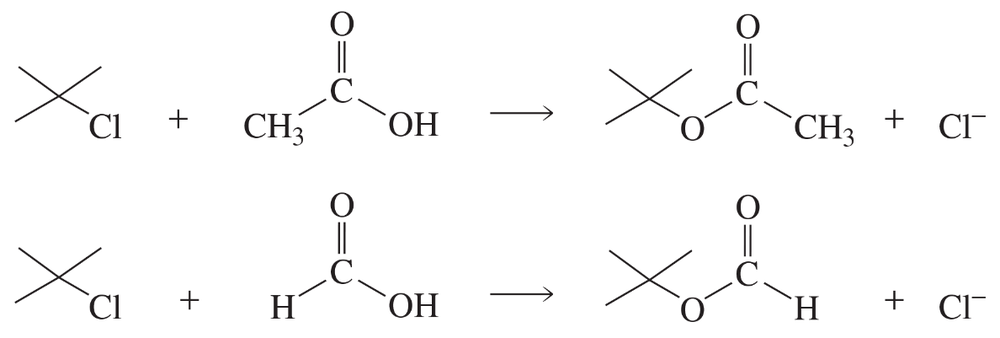
tert-Butyl chloride undergoes solvolysis in both acetic acid and formic acid. Solvolysis occurs 5000 times faster in one of these two solvents than in the other. In which solvent is solvolysis faster? Explain your answer. (Hint: Formic acid is more polar than acetic acid.)

Verified step by step guidance
1
Step 1: Understand the reaction mechanism. Solvolysis of tert-butyl chloride involves the formation of a carbocation intermediate through an SN1 mechanism. The rate of solvolysis depends on the stability of the carbocation and the polarity of the solvent.
Step 2: Analyze the solvents. Formic acid is more polar than acetic acid due to the absence of a methyl group, which makes it better at stabilizing the carbocation intermediate through solvation. Polar solvents stabilize charged intermediates, increasing the reaction rate.
Step 3: Compare the reaction rates. Since formic acid is more polar, it provides better stabilization for the carbocation intermediate formed during the solvolysis of tert-butyl chloride. This leads to a faster reaction rate in formic acid compared to acetic acid.
Step 4: Relate the hint to the observation. The hint specifies that solvolysis occurs 5000 times faster in one solvent than the other. This significant difference in rate is consistent with the higher polarity of formic acid, which accelerates the reaction.
Step 5: Conclude the reasoning. Solvolysis of tert-butyl chloride is faster in formic acid than in acetic acid due to the greater polarity of formic acid, which stabilizes the carbocation intermediate more effectively.

Verified video answer for a similar problem:

This video solution was recommended by our tutors as helpful for the problem above.
Video duration:
4m
Was this helpful?

Key Concepts

Here are the essential concepts you must grasp in order to answer the question correctly.

Solvolysis

Solvolysis is a type of nucleophilic substitution reaction where a solvent acts as the nucleophile. In the case of tert-butyl chloride, the solvent (acetic acid or formic acid) attacks the carbon atom bonded to the chlorine, leading to the formation of a carbocation intermediate. The rate of solvolysis can be influenced by the solvent's polarity and ability to stabilize the carbocation formed during the reaction.
Recommended video:
Guided course
08:16
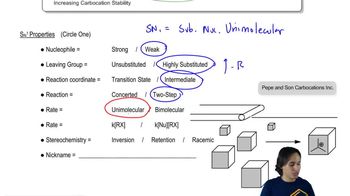
Understanding the properties of SN1.

Polarity of Solvents

Polarity refers to the distribution of electrical charge over the atoms in a molecule. More polar solvents, like formic acid, have a greater ability to stabilize charged species, such as carbocations, due to their strong dipole moments. This stabilization can significantly enhance the reaction rate of solvolysis, making it faster in more polar solvents compared to less polar ones like acetic acid.
Recommended video:
Guided course
01:16
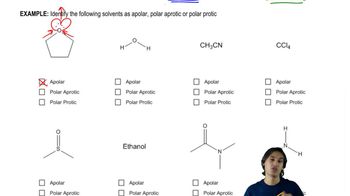
Identification of polarity in solvents

Carbocation Stability

Carbocation stability is a crucial factor in determining the rate of nucleophilic substitution reactions. Tertiary carbocations, such as the one formed from tert-butyl chloride, are more stable than secondary or primary carbocations due to hyperconjugation and inductive effects from surrounding alkyl groups. The stability of the carbocation intermediate is enhanced in polar solvents, which can lead to a faster reaction rate in solvolysis.
Recommended video:
Guided course
05:58
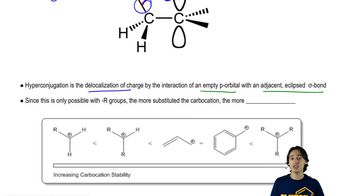
Determining Carbocation Stability