Ch. 9 - Substitution and Elimination Reactions of Alkyl Halides
Bruice - Organic Chemistry 8th Edition
Bruice8th EditionOrganic ChemistryISBN: 9780135213711Not the one you use?Change textbook
Chapter 10, Problem 59

Under which of the following reaction conditions will (R)-1-chloro-1-phenylethane form the most (R)-1-phenyl-1-ethanol: in water or in 1.0 M HO?

Verified step by step guidance
1
Analyze the structure of (R)-1-chloro-1-phenylethane. It contains a chiral carbon bonded to a chlorine atom, a phenyl group, and an ethyl group. The reaction involves substitution of the chlorine atom with a hydroxyl group (-OH) to form (R)-1-phenyl-1-ethanol.
Consider the reaction mechanism. In water, the reaction is likely to proceed via an SN1 mechanism because water is a polar protic solvent that stabilizes the carbocation intermediate. The chlorine atom leaves, forming a carbocation, which is then attacked by water to form the alcohol.
In 1.0 M HO⁻ (a strong base), the reaction is more likely to proceed via an SN2 mechanism. The hydroxide ion directly attacks the carbon bonded to the chlorine atom, displacing the chlorine in a single step. However, SN2 reactions invert the stereochemistry at the chiral center, which would result in the (S)-enantiomer, not the (R)-enantiomer.
Compare the stereochemical outcomes of the two mechanisms. The SN1 mechanism in water can retain the (R)-configuration because the carbocation intermediate can be attacked from either side, but the starting material's configuration is more likely to be preserved. The SN2 mechanism in 1.0 M HO⁻ inverts the configuration, leading to the (S)-enantiomer.
Conclude that the reaction in water will form the most (R)-1-phenyl-1-ethanol because the SN1 mechanism is more favorable for retaining the (R)-configuration, while the reaction in 1.0 M HO⁻ will predominantly form the (S)-enantiomer due to the stereochemical inversion of the SN2 mechanism.

Verified video answer for a similar problem:

This video solution was recommended by our tutors as helpful for the problem above.
Video duration:
3m
Was this helpful?

Key Concepts

Here are the essential concepts you must grasp in order to answer the question correctly.

Nucleophilic Substitution Reactions

Nucleophilic substitution reactions involve the replacement of a leaving group by a nucleophile. In this context, the reaction of (R)-1-chloro-1-phenylethane with a nucleophile (water or HO−) is crucial for understanding how the stereochemistry of the product is influenced by the reaction conditions.
Recommended video:
Guided course
01:47
Nucleophiles and Electrophiles can react in Substitution Reactions.

Stereochemistry and Inversion of Configuration

Stereochemistry refers to the spatial arrangement of atoms in molecules. In nucleophilic substitution, particularly with chiral centers, the configuration can change. The reaction conditions can favor either retention or inversion of configuration, which is essential for determining the stereochemical outcome of (R)-1-phenyl-1-ethanol.
Recommended video:
1:38
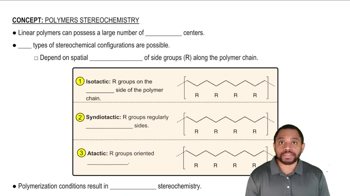
Polymer Stereochemistry Concept 1

Solvent Effects on Reaction Mechanisms

The choice of solvent can significantly influence the mechanism of a reaction. Polar protic solvents like water can stabilize ions and facilitate certain pathways, while polar aprotic solvents can enhance nucleophilicity. Understanding how these solvents affect the reaction of (R)-1-chloro-1-phenylethane is key to predicting the formation of (R)-1-phenyl-1-ethanol.
Recommended video:
Guided course
02:26
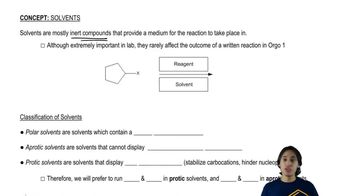
General format of reactions and how to interpret solvents.