Ch. 9 - Substitution and Elimination Reactions of Alkyl Halides
Bruice - Organic Chemistry 8th Edition
Bruice8th EditionOrganic ChemistryISBN: 9780135213711Not the one you use?Change textbook
Chapter 10, Problem 99e

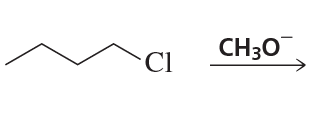
What are the products of the following reactions?
e. Chemical structure showing an alkyl chloride reacting with methoxide ion, indicating a substitution reaction pathway.

Verified step by step guidance
1
Step 1: Identify the type of reaction. The given reaction involves a primary alkyl bromide (1-bromobutane) and a strong nucleophile/base (methoxide ion, CH3O−). This setup suggests an SN2 reaction mechanism due to the primary nature of the alkyl halide.
Step 2: Understand the SN2 mechanism. In an SN2 reaction, the nucleophile attacks the electrophilic carbon (the carbon bonded to the bromine) from the opposite side of the leaving group, resulting in a single-step substitution reaction.
Step 3: Determine the leaving group. Bromine (Br) is the leaving group in this reaction. It will depart as Br−, leaving the carbon atom available for nucleophilic attack.
Step 4: Predict the product. The methoxide ion (CH3O−) will replace the bromine atom on the carbon chain, forming an ether. The product will be butyl methyl ether (CH3OCH2CH2CH2CH3).
Step 5: Verify stereochemistry. Since the reaction follows an SN2 mechanism, the attack by the nucleophile will invert the configuration at the carbon center if it is chiral. However, in this case, the carbon is not chiral, so stereochemistry is not a concern.

Verified video answer for a similar problem:

This video solution was recommended by our tutors as helpful for the problem above.
Video duration:
5m
Was this helpful?

Key Concepts

Here are the essential concepts you must grasp in order to answer the question correctly.

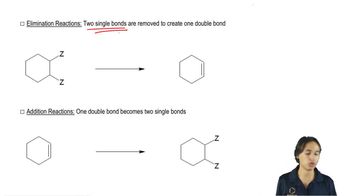
Elimination Reactions

Elimination reactions involve the removal of a small molecule from a larger one, resulting in the formation of a double bond. In this case, the bromide (Br) is eliminated along with a proton (H) from an adjacent carbon, leading to the formation of an alkene. Understanding the mechanism of elimination, such as E2 or E1, is crucial for predicting the products.
Recommended video:
Guided course
00:40
Recognizing Elimination Reactions.

Nucleophiles and Their Role

Nucleophiles are species that donate an electron pair to form a chemical bond. In this reaction, methoxide (CH3O-) acts as a strong nucleophile, attacking the carbon atom bonded to the bromine. This interaction is essential for driving the elimination process and determining the final products of the reaction.
Recommended video:
Guided course
08:27
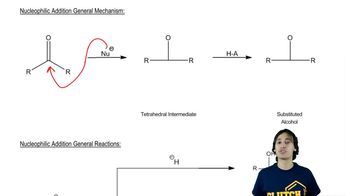
Nucleophilic Addition

Regioselectivity in Elimination

Regioselectivity refers to the preference of a chemical reaction to yield one structural isomer over others. In elimination reactions, the location of the double bond formed can vary, leading to different products. Factors such as sterics and the stability of the resulting alkene influence which product is favored, making it important to analyze the structure of the starting material.
Recommended video:
Guided course
00:38
Intro to Substitution/Elimination Problems