Ch. 9 - Substitution and Elimination Reactions of Alkyl Halides
Bruice - Organic Chemistry 8th Edition
Bruice8th EditionOrganic ChemistryISBN: 9780135213711Not the one you use?Change textbook
Chapter 10, Problem 46a

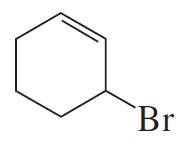
What products will be obtained from the E1 reaction of the alkyl halides in [PROBLEM 9-45]?
a. Bromobenzene structure with a bromine atom attached to a benzene ring, illustrating an alkyl halide for reaction analysis.

Verified step by step guidance
1
Step 1: Identify the alkyl halide structure provided in the image. The molecule is a tertiary alkyl halide with a chlorine atom attached to a carbon in a cyclohexane ring. This structure is favorable for an E1 elimination reaction due to the stability of the carbocation intermediate.
Step 2: Understand the E1 elimination mechanism. E1 reactions proceed via a two-step process: (1) the leaving group (Cl⁻) departs, forming a carbocation intermediate, and (2) a proton is removed from a β-carbon by a base, resulting in the formation of a double bond.
Step 3: Determine the possible β-hydrogens available for elimination. In this structure, there are β-hydrogens on the carbons adjacent to the carbocation formed after the chlorine leaves. These hydrogens can be removed to form different alkenes.
Step 4: Predict the major product based on Zaitsev's rule. Zaitsev's rule states that the most substituted alkene will be the major product. Therefore, elimination of a β-hydrogen from the carbon with the most substituents will lead to the major product.
Step 5: Consider stereochemistry and regioselectivity. The elimination can lead to multiple products, including cis and trans isomers, depending on the orientation of the β-hydrogens. The major product will likely be the most stable alkene with the highest degree of substitution.

Verified video answer for a similar problem:

This video solution was recommended by our tutors as helpful for the problem above.
Video duration:
4m
Was this helpful?

Key Concepts

Here are the essential concepts you must grasp in order to answer the question correctly.

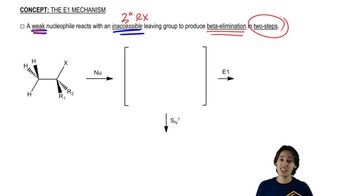
E1 Reaction Mechanism

The E1 reaction is a type of elimination reaction that occurs in two steps: first, the leaving group departs, forming a carbocation intermediate, followed by deprotonation to form a double bond. This mechanism is favored in tertiary alkyl halides due to their ability to stabilize the carbocation through hyperconjugation and inductive effects.
Recommended video:
Guided course
08:09
Drawing the E1 Mechanism.

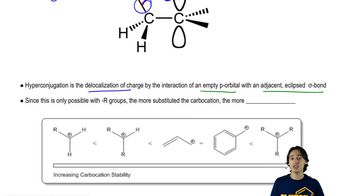
Carbocation Stability

Carbocation stability is crucial in E1 reactions, as more stable carbocations are formed preferentially. Tertiary carbocations are the most stable due to the presence of three alkyl groups that can donate electron density, while primary carbocations are the least stable. The stability influences the rate of the reaction and the products formed.
Recommended video:
Guided course
05:58
Determining Carbocation Stability

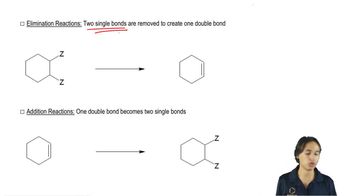
Regioselectivity in Elimination Reactions

Regioselectivity refers to the preference for the formation of one constitutional isomer over others in a reaction. In E1 reactions, the more substituted alkene is typically favored due to greater stability, following Zaitsev's rule. Understanding regioselectivity helps predict the major products formed from the elimination of alkyl halides.
Recommended video:
Guided course
00:40
Recognizing Elimination Reactions.