Ch. 9 - Substitution and Elimination Reactions of Alkyl Halides
Bruice - Organic Chemistry 8th Edition
Bruice8th EditionOrganic ChemistryISBN: 9780135213711Not the one you use?Change textbook
Chapter 10, Problem 14b

Which substitution reaction takes place more rapidly?
b. Chemical structures illustrating two SN2 reaction scenarios with bromine and hydroxide ions.

Verified step by step guidance
1
Step 1: Understand the type of substitution reaction being discussed. Substitution reactions can be classified as SN1 (unimolecular nucleophilic substitution) or SN2 (bimolecular nucleophilic substitution). Each has different mechanisms and factors that influence their rates.
Step 2: Identify the substrate structure. For SN1 reactions, the rate depends on the stability of the carbocation intermediate, which is influenced by the degree of substitution (tertiary > secondary > primary). For SN2 reactions, the rate depends on steric hindrance around the electrophilic carbon (primary > secondary > tertiary).
Step 3: Consider the nucleophile. A strong nucleophile (e.g., OH⁻, CN⁻) favors SN2 reactions, while a weak nucleophile (e.g., H₂O, ROH) is more likely to participate in SN1 reactions.
Step 4: Evaluate the solvent. Polar protic solvents (e.g., water, alcohols) stabilize carbocations and favor SN1 reactions, while polar aprotic solvents (e.g., acetone, DMSO) enhance the nucleophilicity of the nucleophile and favor SN2 reactions.
Step 5: Compare the reaction conditions and substrates provided in the problem to determine which reaction mechanism is more favorable and thus which substitution reaction occurs more rapidly.

Verified video answer for a similar problem:

This video solution was recommended by our tutors as helpful for the problem above.
Video duration:
4m
Was this helpful?

Key Concepts

Here are the essential concepts you must grasp in order to answer the question correctly.

Nucleophilic Substitution Reactions

Nucleophilic substitution reactions involve the replacement of a leaving group in a molecule by a nucleophile. These reactions can occur via two main mechanisms: SN1 and SN2. The choice of mechanism depends on factors such as the structure of the substrate, the strength of the nucleophile, and the solvent used. Understanding these mechanisms is crucial for predicting the rate and outcome of substitution reactions.
Recommended video:
Guided course
01:47
Nucleophiles and Electrophiles can react in Substitution Reactions.

SN1 vs. SN2 Mechanisms

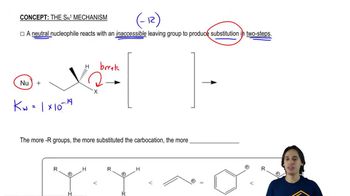
The SN1 mechanism is a two-step process where the leaving group departs first, forming a carbocation intermediate, followed by nucleophilic attack. This mechanism is favored in tertiary substrates due to carbocation stability. In contrast, the SN2 mechanism is a one-step process where the nucleophile attacks the substrate simultaneously as the leaving group departs, typically favored in primary substrates due to steric hindrance. The distinction between these mechanisms is essential for understanding reaction rates.
Recommended video:
Guided course
10:49
Drawing the SN1 Mechanism

Factors Affecting Reaction Rate

The rate of nucleophilic substitution reactions is influenced by several factors, including the nature of the substrate (primary, secondary, or tertiary), the strength and concentration of the nucleophile, the leaving group's ability, and the solvent's polarity. For instance, polar protic solvents stabilize carbocations, favoring SN1 reactions, while polar aprotic solvents enhance nucleophilicity, favoring SN2 reactions. Recognizing these factors helps predict which substitution reaction will occur more rapidly.
Recommended video:
5:07
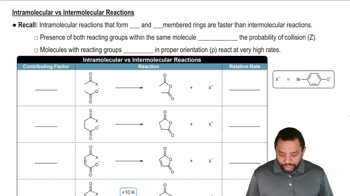
Rates of Intramolecular Reactions Concept 2